Planned Gaza force shaping up despite internal warning


 1
1
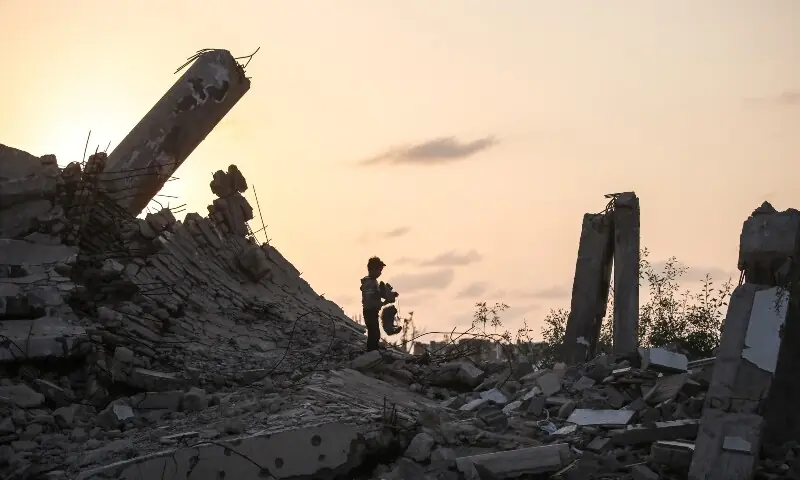

UNITED NATIONS: The United States has circulated a revised draft resolution to establish a two-year mandated stabilisation force in Gaza, setting in motion a process it hopes will lead to adoption by the UN Security Council (UNSC).
The draft, presented to the UNSC on Monday, triggered a “silence” period until 10:30am on Tuesday. Under this procedure, the council’s 15 members must register objections or propose amendments within the allotted timeframe; if none are raised, consensus is assumed and the resolution proceeds to a vote, likely later this week, on Thursday or Friday.
The proposed force would operate under a Board of Peace (BoP), with President Donald Trump as its head. The board would also establish operational entities to oversee Gaza’s reconstruction, economic recovery programmes, and the demilitarisation of non-state armed groups.
Washington has embedded the full “20-point” Trump peace plan into the draft, signalling the United States’ dominant role in shaping the international effort.
Several states remain cautious as US circulates revised draft resolution to be tabled in UNSC
Yet the initiative faces significant diplomatic and practical obstacles. Several countries remain cautious: the United Arab Emirates (UAE) cites legal uncertainties and has refused participation until they are addressed; Jordan has ruled out deploying troops; Azerbaijan says it will join only if a full ceasefire is in place; and Turkey has been excluded at Israel’s insistence.
Indonesia, Pakistan, and other Muslim-majority states that appear willing to contribute forces are also concerned. While they are open to participating in a UN-mandated mission, they “do not want to be a joint B team of the Israeli military focused solely on disarming Hamas,” a UN diplomat explained.
Israel, too, has begun voicing complaints that it is being sidelined, with its liaison unit effectively restricted to limited aid delivery rather than full participation in force planning.
Into this complex mix comes the World Bank’s endorsement. In a letter to Washington, Bank President Ajay Banga affirmed that the institution “backs language in the US-drafted resolution” authorising the two-year BOP mandate and allowing the Bank’s operational engagement in Gaza.
The draft explicitly calls on the Bank and other financial institutions to provide resources for reconstruction, including the establishment of a dedicated trust fund governed by donors. Estimates for Gaza’s rebuilding costs have recently been revised upwards to roughly US$70 billion.
Meanwhile, US media reports on Tuesday revealed deep internal concerns within the Trump administration over the feasibility of the broader peace deal underpinning the resolution.
Documents obtained by Politico show that the administration convened a two-day symposium last month in southern Israel with around 400 participants, drawn from the RAND Corporation, NGOs, and the State and Defence Departments, alongside a newly formed Civil-Military Coordination Center. The event, led by Michael Fenzel, the US security coordinator for Israel and the Palestinian Authority, featured 67 slides across six segments.
Participants were reportedly “concerned about whether a so-called International Stabilisation Force — a multinational initiative meant to maintain peace in Gaza — can realistically be deployed,” the report noted.
Materials obtained by Politico included situation reports on Gaza, advisory documents from the Blair Institute, led by former British Prime Minister Tony Blair, and internal government slides. A US defence official told the newspaper that the documents “reflect the administration’s close-held concerns” about the region’s future. The Blair Institute declined to comment on its involvement but stressed its documents were factual assessments, not policy advocacy.
The report observed that “the mood behind the scenes is more guarded than public statements suggest,” noting that challenges remain in securing troop commitments, clarifying legal and governance frameworks, raising reconstruction funding, and achieving buy-in from Hamas and regional states.
State Department spokesperson Eddie Vasquez, however, dismissed this assessment. “Everyone wants to be part of President Trump’s historic Middle East peace effort,” he told Politico.
“From the moment President Trump announced his 20-point plan, there has been an avalanche of ideas … The Trump administration will continue to uphold the ceasefire and effectively implement the plan,” he added.
Published in Dawn, November 12th, 2025