0
0
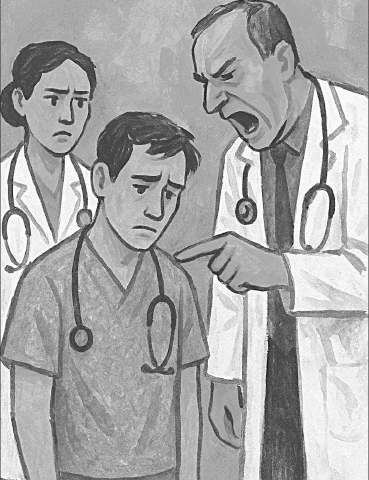
POSTGRADUATE residency is meant to shape young doctors into competent and confident professionals. Supervisors and unit heads are entrusted not only with the task of passing down technical skills, but also with modelling leadership, integrity and compassion. In Pakistan, however, too many residency programmes are marked by something far more corrosive: bullying disguised as teaching.
Across specialities — whether in general surgery, medicine, paediatrics, gynae-cology or any other professional domain — the pattern is disturbingly consistent. Ward rounds often turn into public spectacles of humiliation. Operating theatres echo with shouting and ridicule. Residents are mocked in front of patients and colleagues. Mistakes, instead of becoming opportunities to learn, are punished with sarcasm or verbal abuse.
This is not about the odd ‘difficult personality’. It is systemic. A generation of consultants, who once endured the same treatment, now perpetuate it, convinced that harshness produces ‘tough’ specialists.
But instead of resilience, this culture produces burnout, silence and fear. Trainees avoid asking questions lest they be ridiculed. Errors are hidden rather than openly discussed. Some residents, exhausted by humiliation, quietly consider abandoning the training altogether. Others seek training abroad, fuelling the ongoing brain drain.
The consequences extend beyond the wellbeing of doctors. Patients, too, are affected when their caregivers are trained in fear instead of support. A resident who hides mistakes to avoid reprimand, which happens frequently, endangers patient safety. A trainee too anxious to clarify a doubt risks repeating it in the wards. A system that normalises bullying ultimately fails the very people it is meant to serve.
Our institutions cannot just look away. The Pakistan Medical and Dental Council (PMDC) and the College of Physicians and Surgeons Pakistan (CPSP) bear the responsibility of ensuring that training environments meet both academic and ethical standards; just listing these objectives as part of the standard operating procedures (SOPs) is not enough.
Workplace harassment laws must be applied within hospitals, including wards and operating theatres. Hospitals should establish formal mechanisms for residents to report abuse without the fear of retaliation. Supervisors themselves should undergo structured training in mentorship, communication and leadership — not just bedside manners and surgical techniques.
Other countries have moved beyond this outdated sink-or-swim model. Structured teaching programmes, simulation-based trainings, and constructive feedback systems have proven that mutual respect strengthens doctors far more than inti-midation ever can. Pakistan’s surgical or medical training must evolve as well, or risk falling further behind, which sadly, it already has.
In case of surgery, it demands toughness, but toughness is not cruelty. A true mentor challenges without humiliating, corrects without crushing, and leads without demeaning. In the last five years since graduation, I have only seen one or two individuals who had these qualities.
If we want to produce physicians and surgeons who are both skilled and compassionate, we must break the toxic cycle of bullying in hospitals, and replace it with genuine and sustained mentorship. Our medical residents and, indeed, our patients deserve nothing less than that.
A. Rehman S.
Karachi
Published in Dawn, November 10th, 2025