
Karachi’s urban context is characterised by dense and narrow streets, frequent and long power outages, limited ventilation, and a general inability to afford air-conditioning, which often results in energy theft. In such environments, making green building codes mandatory is a required shift from governing and development bodies. Temperatures are rising every year, as is inflation, making thermal comfort unaffordable for lower as well as middle-income groups.
Regulations can be tailored to development size, with support mechanisms for enforcement, legal implications, and economic benefits of each law. Right now, most green ratings, such as LEED [Leadership in Energy and Environmental Desigh] or EDGE [Excellence in Design for Greater Efficiencies], are only relevant for high-end projects, therefore irrelevant for low- and middle-income developments.
Karachi’s current bylaws require that rooms in a building or house have a minimum percentage of openings or windows; for example, in a living room the opening size should be 10 per cent of the area of the room; this changes to 7.5pc for other rooms and 15pc for the kitchen.
All this looks impressive on paper, but that does not guarantee human comfort. These regulations were written decades ago, focusing on hygiene, and are not practical for today’s extreme heat.
The city’s building codes must take into account the sweltering heat when most of its people can’t afford to keep cool
Building codes in neighbouring countries, like India, or international standards like ASHRAE [American Society of Heating, Refrigerating and Air Conditioning Engineers] are focusing on performance. Instead of specifying how big a window should be, we need to ask basic design questions like, ‘Does this room have adequate fresh air? Is it designed to allow cross ventilation?’
The building codes in India ensure cross-ventilation in at least two rooms of every house, while internationally the number of times air should be replaced each hour to keep people comfortable is also specified. Karachi’s bylaws should enforce wind direction consideration and encourage the use of high and low vents, cement lattices, roof turbines, etc to ensure habitability during power outages. Ventilation is considered a formality, but elsewhere it is considered a necessity for making buildings habitable and comfortable.
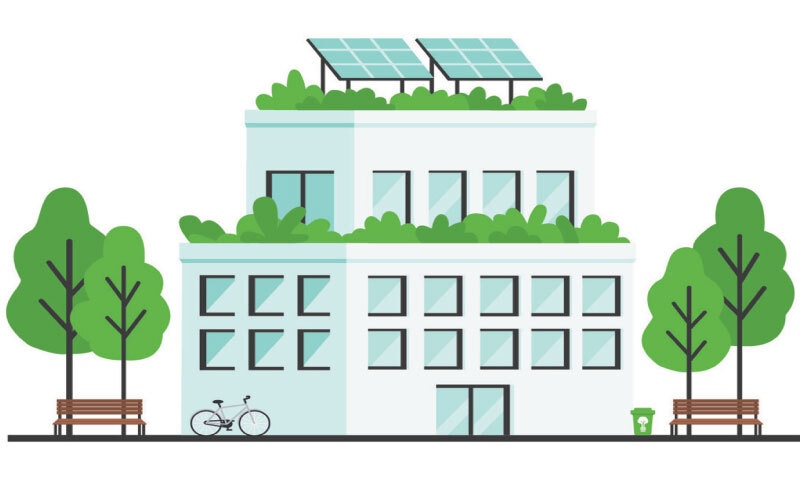
Furthermore, roof cooling treatments should be made mandatory, like reflective lime plaster, reflective paints, or clay tile surfacing. Integration of green roofs in projects above 500 sqm, depending on optimum load capacity, should be compulsory. The CoolRoof Programme in Ahmedabad started as a pilot and is now a municipal regulation, serving as a key example from our own context. In the same vein, the use of solid blocks without insulation should be banned for south-facing external walls. While builders argue against prices of such products, it has overall reduced the structural cost of the building due to reduced load, hence it is more a matter of convenience rather than cost.
Another way to improve comfort is to make all external plaster/paint meet minimum reflectance, hence reflecting the maximum amount of radiation from the sun instead of absorbing it.
Countries like Bangladesh, India, and Egypt have set U-values (how fast heat dissipates) and R-values (the wall’s resistance to heat) for any construction, which mandate the use of insulated materials. Karachi desperately needs such a green building code.
As for the surrounding area, shading devices such as chajjas, verandahs, or sun breakers should be mandatory on south- and west-facing facades. The devices should leave 50pc uncovered yard space that lets rainwater soak in and trees grow, with one shaded tree per 30ft of frontage compulsory.
Efficient water management can also play an important role in cooling our city. Rainwater harvesting pits, permeable paving and low-flow fixtures in homes can help cut wastage. For larger projects, a required portion of grey water (from sinks and showers) is to be recycled for landscaping or flushing. This will ensure that saving water becomes a standard like laying bricks.
For effective implementation, the builder community must foresee the financial value in adopting these rules. While this can bring prestige and recognition in upper-income residential projects, middle- and lower-middle-income group housing needs to be targeted. Bulk procurement, tax breaks and reduced approval fees can be offered as incentives.
Finally, instead of solely relying on government agencies, which are often mistrusted, incentives could be built into the system. For example, housing finance institutions and banks can offer lower interest rates and easier loan terms for greener projects. The creation of bulk-purchasing networks by material suppliers will ensure that eco-friendly products are available at lower prices so the builders naturally shift towards them. Housing cooperatives, neighbourhood associations and buyers’ groups can create a demand for cooler homes; builders will adapt for competition.
These are not luxury ideas but a necessity for survival in a city where most people cannot afford air-conditioning. Government agencies, private institutions and citizens must act with urgency to ensure comfortable living across all income groups.
The writer is an architech and urban planner, currently leading her own practice, “Beyond Facades”
Published in Dawn, The Business and Finance Weekly, October 27th, 2025