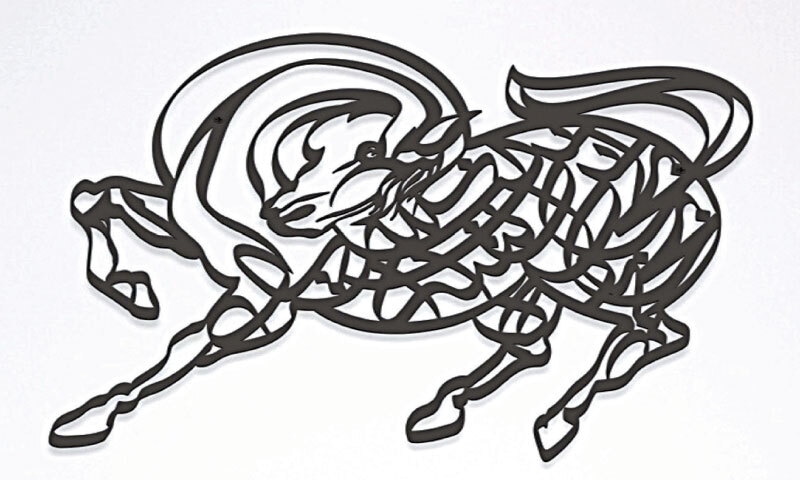
Muzzumil Ruheel’s solo show ‘The Wild in Our Mouths’, at Canvas Gallery in Karachi, was an exploration of the relationship between thought, text, image, sound and space. As has been the nature of Ruheel’s trajectory, the presence of stillness or the unsaid becomes equally audible as, if not more than, the visual in his work.
The current body of work evoked a feeling of liberation, where form wove a joyful dance, flirting with the spectator’s gaze. Cast in welded steel and anchored in the Thuluth script, these calligraphed forms defied convention. They were placed beneath eye level or above reach, thus playing with vision. The emptiness of the white walls insisted on viewing space in relationship to the object. There seemed to be no difference between these walls and the empty white spaces or flat colour areas of Ruheel’s earlier paintings on canvas, wood or paper.
The explored dualities, simplifying the idea, with disregard to boundaries of material or consumer demand. The visual as text, text as image and space as form was the proposition to explore here. The conventional viewing of art is still so predominant within the Pakistani art market and commercial gallery dynamics. Ruheel’s simple gesture can be viewed as a mark of dissent and resistance.
Even so, it is a subtext within the main narrative. One must also keep in mind that here one is literally ‘reading’ the art in the context of the artist’s journey and the places his form has travelled from. Ruheel’s work demands that commitment from the viewer.
Form, text and the gallery space itself were in dialogue with one another at an exhibition in Karachi
There has been a disruption in the age-old script and connotations attached to Thuluth as a form of embellishment of religious manuscripts and architecture. It is a cursive Arabic script that emerged in the seventh century and flourished during the Ottoman Empire. Ruheel’s inscriptions are like sculptural drawings, whose movement and orientation is solely determined by the artist.
He is situated well outside the orbit of a past time, nor does he seem to be replicating it, as has been the tradition. The spontaneity with which he chooses to play with line, exaggerating a curve or extending a line, defines his personal journey and where he chooses to place himself socially and politically.
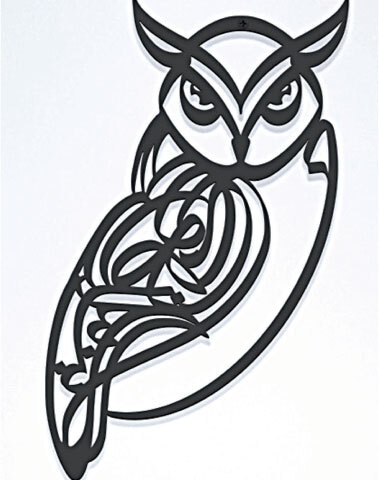
The work alludes to larger questions on the nature of personal, social and political boundaries, expressed through the form. Only an expert calligrapher or a palaeographer can truly gauge the diversions in Ruheel’s use of script. We recognise some letters due to the familiarity of reading and writing in Urdu and Arabic. We are well attuned to the rigour of mashq or practice that strives for perfection and can see that Ruheel adheres to the discipline of his early training in calligraphy required for a compelling flow of line.
How far he deviates is dependent on the viewer to recognise, but one thing is for sure: the artist is having fun with form through language, which defies containment and expectation. He, therefore, charts a direction that creates unfamiliar pathways of seeing and ‘reading’.
Ruheel instantly places tradition off the pedestal, making it approachable and ordinary. He injects his story within recycled imagery off the internet, shattering the myth of the original in art. The title or captions carry a parallel commentary that completes the work. The form of a horse was calligraphed, carrying the text, “Where are your Reins?” and in brackets the translation in Urdu and direct translation in English: “Tumhari lagam kahan — Where is your leash?”
Another work, Can’t Argue with Genius, which he translated as “Ji Aap Sahi Keh Rahey Hain — Of course You Always Know Best.” This tongue-in-cheek sarcasm and commentary, inserted in the captions to the work, conveys the loss in meaning in translation from Urdu to English, and vice versa. It brings home the realisation of a colonised mindset, where we constantly need to translate and clarify, as if this was addressed to an English-speaking audience.
Ruheel comes from a place of familiarity with Urdu literature, as he fondly refers to the wide range of his inspirations, from Mushtaq Ahmad Yusufi to Ibne Insha’s famous Urdu Ki Aakhri Kitab. This knowledge seeps into the nuances, punctuations and humour as he narrates, in his words, “this chapter.”
‘The Wild in Our Mouths’ was on display at the Canvas Gallery in
Karachi from September 16-25, 2025
The writer is an independent art critic, researcher and curator based in Karachi
Published in Dawn, EOS, October 26th, 2025