IMF agreement, US trade deal ‘imminent’
• Aurangzeb says govt poised to seal staff-level agreement this week
• Pakistan, US to announce trade framework within fortnight
• Green Panda launch by Dec, $1bn global bond next year
• Reko Diq, oil financing projects discussed with lenders
WASHINGTON: Finance Minister Muhammad Aurangzeb has said that Pakistan and the International Monetary Fund (IMF) are expected to sign a staff-level agreement (SLA) this week, unlocking a $1.24 billion tranche as part of an ongoing loan programme.
Speaking with members of the Pakistani-American community and the media in Washington, Mr Aurangzeb also indicated that Pakistan and the United States would soon issue a joint statement on bilateral trade, to be followed by a framework agreement.
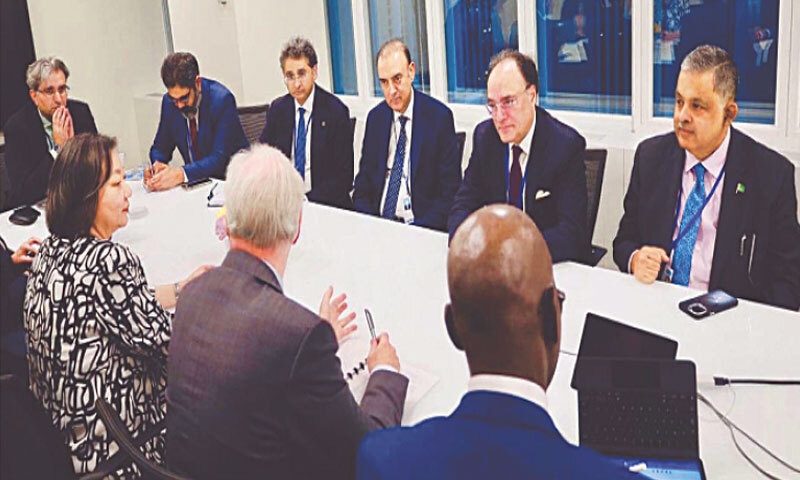
“During this week, we hope to finalise the staff-level agreement with the IMF,” the finance minister said while attending the annual meetings of the IMF and World Bank Group.
He described the SLA as a key step for releasing the next tranche of IMF funding under the $7bn Extended Fund Facility and the $1.4bn Resilience and Sustainability Facility agreed in 2024 to stabilise Pakistan’s economy.
An IMF mission visited Pakistan earlier this month, focusing on quantitative and structural benchmarks, but left without signing the SLA.
“The mission was on the ground for a couple of weeks, and we engaged in very constructive discussions with them on the benchmarks. Follow-up discussions have continued,” the minister told reporters.
The IMF programme, agreed in September 2024, has helped stabilise Pakistan’s economy, which was previously hit by record-high inflation, a depreciating currency and a widening external deficit. Mr Aurangzeb also shared that the government plans to launch Pakistan’s first green Panda bond, denominated in Chinese yuan, by December.
He further said Pakistan intends to return to international markets next year with a bond sale of at least $1bn, although details are still being finalised.
He highlighted ongoing efforts to accelerate the privatisation of state-owned assets, including three power distribution companies and the national carrier, Pakistan International Airlines (PIA), as part of the country’s economic reform and fiscal stabilisation agenda required by the IMF.
US-Pakistan trade deal
Earlier, following meetings with senior US Treasury officials, Mr Aurangzeb expressed hope that negotiations would soon lead to a tariff deal with the United States.
According to sources in Washington, a joint statement is expected within 15 days, to be followed by a framework agreement.
In discussions with US officials, the finance minister emphasised Pakistan’s improving economic fundamentals under the IMF programme. He briefed officials on legislation regulating virtual assets in Pakistan and invited US companies to invest in the oil and gas, minerals, agriculture and IT sectors.
At a gathering in Washington, Mr Aurangzeb noted that Pakistan is working to establish a fair and effective arbitration mechanism for trade disputes, a step urged by US lawmakers to encourage investment.
In a separate meeting with the US-Pakistan Business Council, the minister highlighted improvements in Pakistan’s macroeconomic indicators and stressed that the private sector must lead the country’s growth.
He reaffirmed the government’s commitment to providing relief to businesses and expressed optimism about enhanced government-to-government (G2G) and business-to-business (B2B) engagement with US firms, particularly in mining, agriculture, IT and pharmaceuticals.
During a meeting with representatives of Citibank, Mr Aurangzeb provided an overview of Pakistan’s stabilising economy, driven by ongoing structural reforms validated by international credit rating agencies. He also highlighted Pakistan’s emergence as a growing hub for digital innovation and financial services.
Engagement with financial institutions
In a meeting with Riccardo Puliti, regional vice president of the International Finance Corporation (IFC) for the Middle East, Central Asia, Turkiye, Afghanistan and Pakistan, Mr Aurangzeb appreciated the IFC’s partnership in scaling up private sector investment through the 10-year Country Partnership Framework.
He agreed to achieve early financial closure for the IFC’s flagship Reko Diq project and welcomed the IFC’s new regional office in Islamabad. In discussions with Muhammad Sulaiman Al- Jasser, president of the Islamic Development Bank, the minister reviewed the bank’s ongoing projects in Pakistan and emphasised the importance of faster project implementation.
Both sides agreed to continue cooperation in polio eradication efforts and the oil financing facility, expressing the need to establish a new Country Engagement Framework for Pakistan.
Published in Dawn, October 15th, 2025