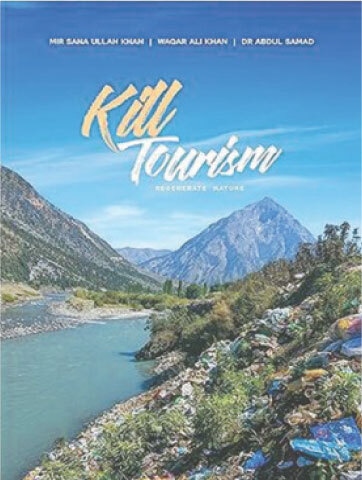
Kill Tourism: Regenerate Nature
By Mir Sana Ullah Khan, Waqar Ali Khan and Dr Abdul Samad
Sang-e-Meel Publications
ISBN: 978-9693536935
228pp.
In an era of mounting overtourism protests, from Barcelona’s anti-tourist graffiti to Venice’s entry fees, Mir Sana Ullah Khan, Waqar Ali Khan and Dr Abdul Samad offer a provocative intervention with Kill Tourism: Regenerate Nature.
Here is the bold primary claim: tourism cannot be reformed because it is structurally designed as “a system of extraction, enclosure and transformation masked as leisure.” The argument goes beyond critiquing overtourism to challenge tourism’s very existence. They propose instead “Tourservation”, which is a “new” framework grounded in community sovereignty, ecological regeneration and the fundamental “right to refuse” visitors entirely.
The authors envision Community Tourism Councils, with significant authority to control all visitor access, reject unwanted development, and govern territory according to customary law rather than state directives. Their central thesis is that communities should be recognised not as “stakeholders” in tourism but as “rightful owners and governors of their territories”, capable of enforcing decisions through collective action and traditional governance structures.
I should make it clear that the authors succeed in several ways. Their diagnosis of tourism’s structural problems is often incisive, particularly their analysis of how “sustainable tourism” and “community-based tourism” can become forms of ‘greenwashing’ that legitimise continued extraction. Their documentation of tourism’s impacts in Pakistan, from Murree’s environmental degradation to the commodification of cultural practices in the northern areas, provides excellent local context often missing from global tourism discourse. This is a significant contribution for both scholars and policymakers.
Despite some analytical weaknesses, a new book about tourism succeeds as an intellectual provocation, challenging readers to examine assumptions about travel, development and community autonomy
Politically, ‘tourservation’ makes genuine — albeit controversial — contributions, by prioritising community sovereignty and communities’ right to refuse tourism altogether. This challenges the pervasive assumption that communities must always welcome visitors, offering a framework for thinking about consent and self-determination in tourism development. It may sound utopian, or it probably is. Regardless of that, their emphasis on ecological regeneration over mere sustainability also pushes important conversations about what recovery actually requires.
My first, and most basic, concern is that the book, which aims to influence policies, suffers from several serious analytical weaknesses that likely limit its policy relevance. Most fundamentally, the authors propose that communities should exercise sovereignty over territory while remaining within nation-states. This sounds like a conceptual impossibility, since sovereignty is legally indivisible.
Their Community Tourism Councils would ideally require authority over visa regimes, border controls and legal frameworks that states claim exclusive jurisdiction over, yet the authors provide no theory of how such parallel governance would gain recognition or enforcement capacity. I think they could have been more nuanced in their discussion of the state’s role and the overall role of the proposed councils. They would ideally operate under the state’s watch. This brings me to my next point.
Throughout the book, the treatment of state capacity reveals, quite astonishingly, particular inconsistencies. While calling for states to “stop incentivising visitor growth” and to redirect resources toward regeneration, the authors offer no analysis of why states would voluntarily dismantle revenue-generating tourism industries or how bureaucratic institutions might be restructured to support Tourservation principles.
In the final part of the book, the authors try to present Sheikh Badin as a pilot project and application of their theory/proposed policy. The case study represents an ambitious attempt to operationalise Tourservation principles in practice. While the detailed governance structures and economic models demonstrate serious engagement with implementation, several questions remain about the project’s feasibility within Pakistan’s existing legal and institutional frameworks.
The most basic question remains about how Community Tourism Councils would gain formal recognition, secure sustainable funding independent of state tourism budgets, and maintain autonomy from competing development pressures. And if the state comes in, it will have its own interests.
Moreover, the broader question of cultural sovereignty, while central to the authors’ framework, raises serious issues about community boundaries and inclusion, which deserve continued attention as implementation proceeds. How communities define membership, manage internal disagreement and engage with surrounding areas will be crucial for the project’s long-term viability and replicability.
Despite these limitations, Kill Tourism makes important, and maybe some controversial, contributions to critical tourism studies and development discourse. The authors correctly identify tourism’s extractive dimensions and attempt to offer a framework for thinking beyond conventional sustainability approaches. Their work joins a growing body of scholarship questioning development orthodoxies and advocating for more radical alternatives.
The book succeeds as an intellectual provocation, challenging readers to examine assumptions about travel, development and community autonomy. For activists and scholars, it provides useful and timely conceptual tools and a comprehensive critique of tourism’s limitations.
While the analysis offers limited practical guidance for policymakers constrained by existing institutions, it nonetheless challenges conventional approaches to policymaking.
The reviewer is a Religion and World Affairs Fellow at the Institute on Culture, Religion & World Affairs at Boston University
Published in Dawn, Books & Authors, October 12th, 2025