WASHINGTON: The largest stars in the universe live the life of a rock star — they are born brilliant, live fast and die young. If that is the case, the one named WOH G64 might be considered the stellar equivalent of Jimi Hendrix.
WOH G64, which is 28 times the mass of the sun and resides in a satellite galaxy to the Milky Way called the Large Magellanic Cloud, is one of a handful of the biggest stars known, just like Hendrix was in rock ‘n’ roll. And observations spanning more than three decades show it is behaving unlike any star seen before.
Astronomers have only an incomplete understanding of the life history of the largest stars, and the WOH G64 observations are providing new insight. Researchers observed a change that occurred in 2014 in the star’s colour, corresponding to an increase in its surface temperature, as it evolved from red to yellow. The star had been classified as an extreme red supergiant but rapidly became a yellow hypergiant. This transition happened quickly, in cosmic terms, and with no evidence of an eruption or explosion.
“Typically the evolution of a star takes place on timescales of billions of years. On human timescales, we only observe more abrupt and violent events, such as eruptions, the merger of two stars or their explosive deaths,” said astronomer Gonzalo Muoz-Sanchez, lead author of the research published this week in the journal Nature Astronomy.
“No current stellar models can fully explain this transformation” in WOH G64, said Muoz-Sanchez, who worked on the study at the National Observatory of Athens.
Compared to the sun, its luminosity is about 300,000 times greater and its diameter about 1,500 times greater. If it were in the place of the sun, its surface would extend to a distance between the orbits of Jupiter and Saturn, our solar system’s fifth and sixth planets. Traveling at the speed of light would take six hours to circumnavigate the star’s surface.
WOH G64, around 10 million years old, appears to be near the end of its lifespan. In contrast, the sun is about 4.5 billion years old and has an estimated 5 billion more years left. WOH G64 is located about 160,000 light-years from Earth. A light-year is the distance light travels in a year, 5.9 trillion miles (9.5 trillion km).
“WOH G64 is a massive star and very different from the sun,” Muoz-Sanchez said.
Stars between about eight and 23 times the sun’s mass are expected to evolve into red supergiants and eventually explode as a supernova. For stars in the range of 23 to 30 times the sun’s mass, their fate is less certain. It remains unclear whether they go boom as a supernova, collapse directly into forming a black hole or evolve from a red supergiant phase into a yellow hypergiant stage before ending their lives. Black holes are exceptionally dense objects with gravity so strong not even light can escape.
“Hence, WOH G64 might be the solution to this question,” Muoz-Sanchez said.
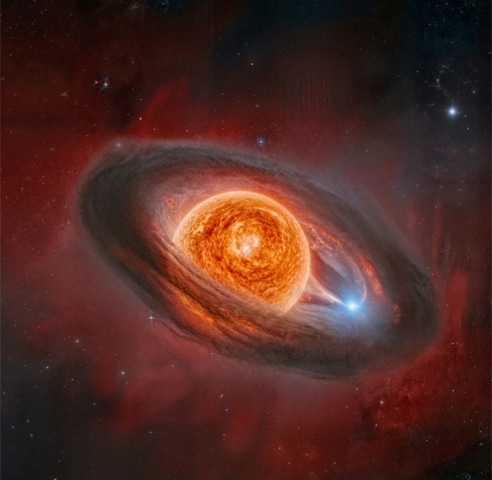
Adding another layer of complexity to understanding WOH G64 is the fact that the observations indicated it is gravitationally bound to another star in what is called a binary system. The researchers were unable to determine the size or characteristics of the stellar companion, but said the two might at some point merge. The researchers have come up with hypotheses concerning WOH G64’s recent changes. They said it may have experienced a violent episode predating the observational data that turned it red and is now returning to its usual yellow quiescent state.
Published in Dawn, March 1st, 2026