• Ahsan Iqbal irked by ‘indifference’ of relevant ministers, Punjab and Sindh representatives
• Minister underscores limited window to support farmers; forms three task forces
• KP minister urges committee to formulate aid package proportionate to provincial NFC shares
• Punjab announces tax break for flood-hit areas, will start handing out compensation cheques to survivors from today
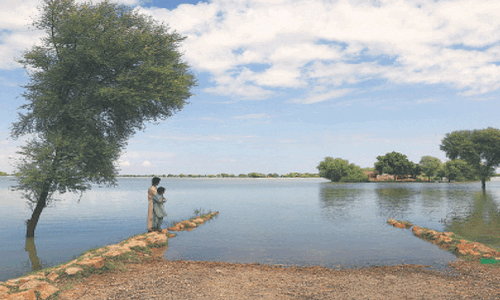
ISLAMABAD/LAHORE: A high-powered cabinet committee on agriculture, climate change and flood emergencies on Monday put out in the open a nonchalant approach of the federal ministers and provincial governments towards flood-loss assessment ahead of a support package by Prime Minister Shehbaz Sharif expected by the end of this month.
At the start of the first meeting of the cabinet forum, committee convener Planning Minister Ahsan Iqbal was irked by the absence of federal ministers for finance, water resources, housing, climate change and power and their subordinates from the meeting.
Similarly, he also took exception to the lack of representation from Punjab and Sindh, saying he would report this non-serious attitude on such a grave issue to the prime minister.
Subsequently, the water, climate, power, and housing ministers showed up at the meeting. Sindh was apparently conspicuous by its absence, coinciding with PPP’s walkout from the National Assembly due to a political rift with the PML-N, while flood-ravaged Punjab was represented by a special secretary.
Balochistan’s minister for agriculture was present along with KP’s ministers for agriculture and finance, whose preparedness and contribution were appreciated by Mr Iqbal.
The planning minister deplored that the Rabi season was now starting that offered a window of no more than two weeks for the government to support the flood-affected farmers and lead them towards a new crop with greater financial value. Instead, he suggested the use of canola, priced around $700 per tonne in the international market, compared to $250-300 per tonne for wheat.
KP’s agriculture minister reported that his province was already at the cusp of an olive revolution with the plantation over around 700,000 acres, potentially sufficient to meet all of Pakistan’s requirement within a period of 3-4 years.
The province had also been fortunate to have successful plantation of saffron to follow soon. In the short term, he reported, the KP government was providing free seeds and fertilisers from its own resources and was in touch with the Asian Development Bank and the World Bank for a comprehensive support package for rain- and flood-affected people.
KP’s Finance Minister Muzammil Aslam proposed that the PM’s package for flood-affected people should not be Punjab and Sindh centric in the name and cost of smaller provinces.
He demanded that it should be proportionate to provincial National Finance Commission (NFC) shares so that gas subsidy for fertilisers was not consumed only in Punjab or for political reasons in Sindh, given the fact that KP ultimately also faced the difficult situation from a ban on the wheat trade. The sources said the planning minister acknowledged that KP’s stance over the past 18 months at all national forums had been from a national perspective and above provincial and political angles.
Mr Iqbal was unhappy to know that despite flood devastations, the Ministry of National Food Security and the provinces had poor coordination over flood losses and both sides were waiting for each other. “We do not have unlimited time to waste while the opportunity is slipping through,” he was quoted as saying.
A representative of the Punjab government reported that the chief minister had been informed about the loss of crops planted on 2500,000 acres and the CM had set a target of wheat sowing over 16.5 million acres, up from 16.25m acres last year. Mr Iqbal hoped this target was also backed by an implementable plan.
The minister assured the provinces that a cabinet committee at the federal level had been constituted by the prime minister for a joint and coordinated plan and did not mean any federal intrusion. At the planning division, “we are here to provide you all a helping hand” for a better response.
Task forces formed
He also formed three dedicated task forces in consultation with the federal ministries concerned and the provincial governments. These task forces will prepare detailed reports within 15 days covering immediate agricultural relief and provision of seeds, climate change impacts and resilience strategies, and strengthening infrastructure to make it climate-resilient in the long term. These reports will be presented to the PM for final consideration.
He said providing short-term, medium-term, and long-term relief to farmers was the government’s foremost priority. “Provincial governments, in partnership with the federal government, must take swift steps to ensure that affected farmers are compensated and supported for the upcoming Rabi season,” he said, underlining the urgency of supplying canola seeds to farmers within the next 15 days, taking advantage of the soil moisture left behind by the floods. “I have arranged a 5,000-acre canola seed pilot project in Narowal through corporate sponsorship, because we cannot afford to lose time. This is a moment for urgent action—we must not waste it,” he said.
He also indicated the importance of extending interest-free loan schemes to the farmers through financial institutions and to gradually moving towards private insurance mechanisms to protect them from recurrent climate shocks.
It may be noted that the PM had constituted the committee last month to formulate, in collaboration with provincial governments, an agricultural support package to provide immediate relief to farmers affected by the recent floods.
Tax exemption for Punjab
Separately, the Punjab government announced tax exemptions for flood-hit areas, initiating compensation from Oct 7. The Punjab cabinet meeting presided over by Chief Minister Maryam Nawaz approved a 171-point agenda, endorsing a series of initiatives mainly focused on flood rehabilitation.
“The distribution of compensation cheques among flood-affected families will begin from October 7,” the CM said. Compensation for damaged houses, livestock losses, and crop destruction was also approved, along with waivers on ‘Aabiana’ and agricultural income tax in 2,855 flood-affected villages in the province.
The cabinet approved the flood relief package under which Rs1 million would be given to the family of a deceased while Rs500,00 and Rs300,000 would be paid to a person with permanent and partial disability, respectively.
“The family of a fully damaged concrete house will get Rs1 million in compensation, while partially damaged concrete house will have Rs300,000. The family of fully damaged mud house will be paid Rs500,000 while Rs150,000 for a partially damaged mud house.”
Published in Dawn, October 7th, 2025