Neglected Chehel Abdal Peak holds untapped tourism potential
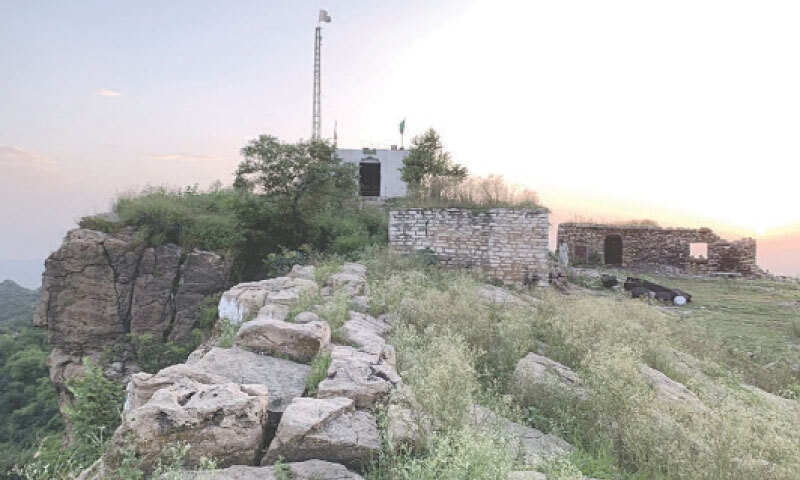


What makes mountain peaks more striking? Surely, a shrine or a Chilagah (a place where an ascetic or saint performs spiritual practices for forty days — the word chilla is derived from the Persian word chehel, meaning 40) or a fort nestled at the top.
Be it Mount Olympus in Greece, Mount Sinai in Egypt, or Mount Kailash in China, such sites are still revered. In Pakistan, too, many shrines, Chilagahs and forts crown the peaks of mountains and the enchanting Salt Range is dotted with such sites.
One of the most prominent among them is the peak of Chehel, also known as Chail, commonly referred to as Chehel Abdal.
At 3,701 feet, it is the second-highest peak in the Salt Range after Sakesar (5,003 feet) and the highest point of Chakwal, Jhelum and Mianwali districts. Located 38km from Chakwal city and about 40km from the Kallar Kahar Interchange, Chehel Abdal offers panoramic views of the Salt Range’s scenic valleys, making it a mirror of the region’s natural beauty.
Two routes from Chakwal city lead to Chehel Abdal. One is the Chakwal–Choa Saidan Shah Road, which branches into Jhangar Valley from Siraeen Chowk and is called the Aara-Basharat Road. From Lari Shah Nawaz village on this route, another link road diverges left, passing through Bharwal and leading to Chehel Abdal.
Reaching the peak, however, is a daunting task. Cars cannot traverse the rocky and narrow track, littered with small boulders and flanked by thick groves of phulahi (Acacia modesta), kahu (Olea ferruginea) and sanatha (Dodonaea viscosa).
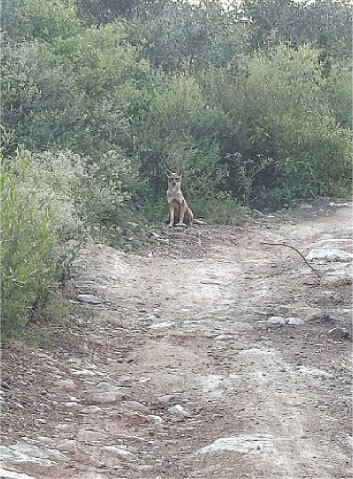
This stretch serves as a habitat for jackals, wild boars, francolins, and other species of wildlife. Yet, if one has the stamina to trek for an hour and a half, or access to a motorbike or jeep, the peak is within reach.
Another route to the site is via Choa Ganj Ali Shah–Lari Shah Nawaz Road, branching off the main Chakwal–Jhelum Road and passing through Khanpur village.
This entire stretch is scenic, but when the road pierces through the Diljabba Mountain, the views are mesmerising, as the mountain is regarded as the most captivating in the eastern Salt Range.
At the summit, visitors find themselves in another world. Even in the scorching months of June and July, cool southern winds at sunset often force one to seek a blanket. On a clear day, flashes of the Jhelum River are visible from the peak.
“Chehel Abdal is the third-highest point in Punjab. From here, you can see different lakes of Chakwal, and the remains of Kussak Fort are also visible,” said Yasin Chaudhry, a well-known traveller from Chakwal.
He described it as Punjab’s most accessible peak for tourists. “In cloudy weather, the clouds hover beneath the peak, while Karangal, another peak at the end of the same mountain, also offers breathtaking views,” he added.
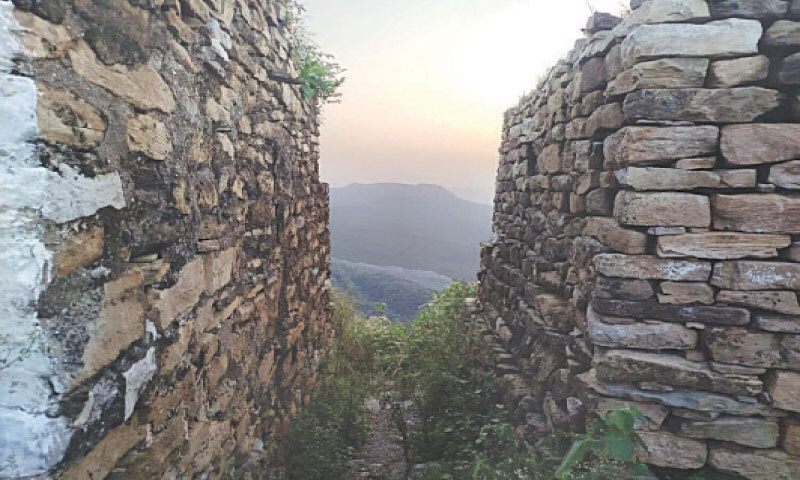
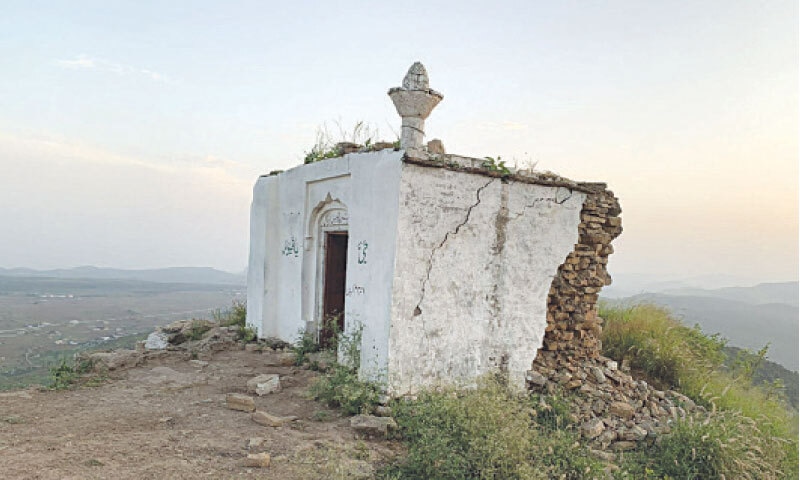
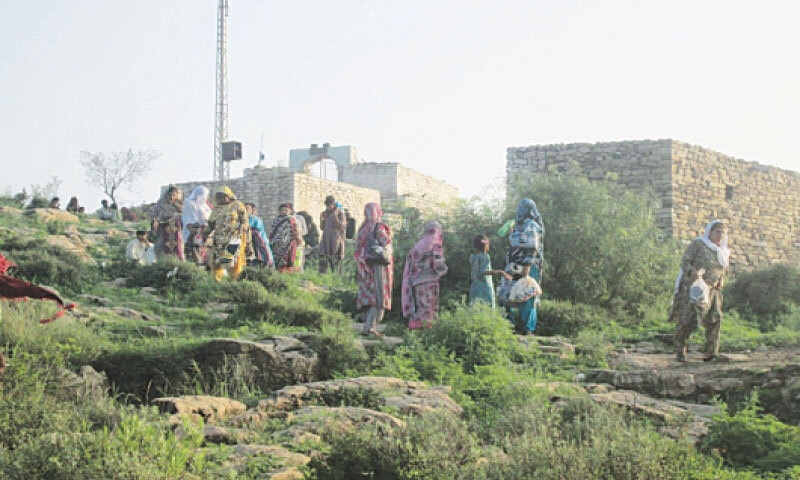
At the top stand five limestone rooms, now crumbling and a mosque, part of which collapsed during the July 16–17 rains. The site attracts adventurous visitors as well as those seeking to fulfill their wishes.
The latter sacrifice roosters and goats, which are then cooked and distributed among those present.
A self-appointed caretaker, Ghulam Qadir of Basharat village, provides cauldrons and cooking utensils. “Childless couples and parents of special children come here for 40 consecutive Thursdays to seek relief and their prayers are answered,” Qadir said.
An electric pole, though devoid of electricity, stands at the peak with Pakistan’s flag fluttering atop it, alongside colourful flags on the roofs of the rooms. “We had solar panels for lighting, but someone took the battery before Eidul Azha,” Qadir quipped.
Legend has it that 40 Abdals (Sufi saints of the fifth order) once worshipped at this peak, though their names and era remain unknown. Some locals believe the 40 Abdals were brothers. Interestingly, the Imperial Gazetteer of India’s provincial series on Punjab and the 1904 Gazetteer of Jhelum District do not mention the word “Abdal” in connection with Chail or Chehel.
Despite being one of Chakwal’s most famous tourist attractions, Chehel Abdal Peak urgently needs attention. Parthenium hysterophorus, locally known as gajar booti and regarded as the deadliest weed, has spread across Punjab’s mountains and plains, engulfing Chehel Abdal as well.
During his tenure as provincial tourism minister, Raja Yassir Humayun Sarfraz, who had declared Chakwal the ‘The Lakes District’, installed a gazebo at the site, but its planks are now broken.
“Developing hiking tracks, repairing gazebos, and installing zip-lines could significantly boost tourism here,” Raja Yassir told Dawn.
Published in Dawn, September 22nd, 2025