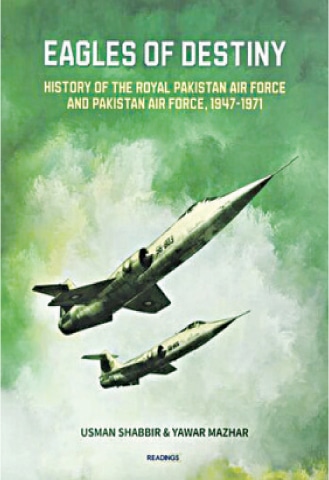
Eagles of Destiny: History of the Royal Pakistan Air Force and Pakistan Air Force, 1947-1971
By Usman Shabbir and Yawar Mazhar
Readings
ISBN: 978-627-510-057-7
223pp.
Pakistan’s swift response to India’s attacks in May this year, with its air defence downing so many French-made Rafale jets of the Indian Air Force — the first time any of the 4.5 generation fighter planes had ever been shot down — and whatever else lingered in their shadow, has jolted fresh interest in the Pakistan Air Force (PAF).
The book Eagles of Destiny: History of the Royal Pakistan Air Force and Pakistan Air Force, 1947-1971, therefore, seems like an excellent choice to read up more on the PAF and how it got to where it is today.
The book’s authors, Usman Shabbir and Yawar Mazhar, are both aviation enthusiasts. Usman carries a deep interest in Asian air forces while Yawar is passionate about military aviation and has, over the years, collected lots of information about PAF’s history and development, through interviewing many of its officers who played a key role in its growth.
Like a very able pair of pilot and co-pilot, they take you up on a smooth ride in the skies to provide you with a bird’s-eye view over Pakistan right from 1947 — when the PAF was nothing but a token force that went by the name of the Royal Pakistan Air Force (RPAF). By 1971, it had grown to face a much bigger and better-resourced adversary.
As the country celebrates its Air Force Day today, a timely book provides the story of the Pakistan Air Force, from its inception till 1971
When Pakistan declared itself a republic in 1956, its air force also dropped the ‘Royal’ prefix, to embark on a new journey of development as an air force as well as an organisation. But let’s go back even further to understand how military air power grew in the Subcontinent.
Even though aircraft arrived in British India only a few years after they flew in Europe, the colonial Indian government was not in favour of developing military air power in India, as they could not visualise natives flying war aircraft. But the difficult and mountainous border area of India’s North-Western Frontier Province (NWFP), populated by hostile tribes who considered themselves autonomous of any central authority, and who indulged in off and on skirmishes with them, was a perpetual concern for British India. It was with this constant threat in mind that the Viceroy of India requested the British government to provide air support as a Royal Flying Corps (RFC) detachment.
As a result, RFC’s No 31 Squadron — with its ‘A’ flight including three BE 2c aircraft providing air support in the shape of bombing, strafing, reconnaissance and wireless ranging for artillery — started operating from Risalpur in 1916. Later, in 1917, another RFC unit — the 114 Squadron — was raised in Lahore from some aircraft provided from the initial 31 Squadron.
Additional units of the Royal Air Force were stationed in India after the First World War. By 1930, after the establishment of military colleges in India, and the creation of the Indian Air Force (IAF), natives started getting commissioned as officers in various technical arms of the IAF, such as artillery, signals, air etc.
In early 1942, during the Second World War, the IAF’s No 1 Squadron was deployed in Burma (Mayanmar) against Japanese forces. Significant efforts to build the air arm in India by the British government saw the setting up of structured training facilities for pilots and other technical personnel.
The partition of the Subcontinent in 1947 brought about the division of the existing armed forces in India. Pakistan inherited the troublesome NWFP, along with threats from the Soviet Union. Pakistan’s requirement was a minimum of five squadrons, consisting of four fighter squadrons and one transport squadron. But it only got three squadrons, including two fighter squadrons and one transport squadron.
India had almost four times the number of fighter aircraft allocated to Pakistan. They also had a large number of aircraft left in India after the Second World War. Plans to expand the IAF, including the development of an operational infrastructure, were also well on their way. Pakistan faced a growing Indian air power capability.
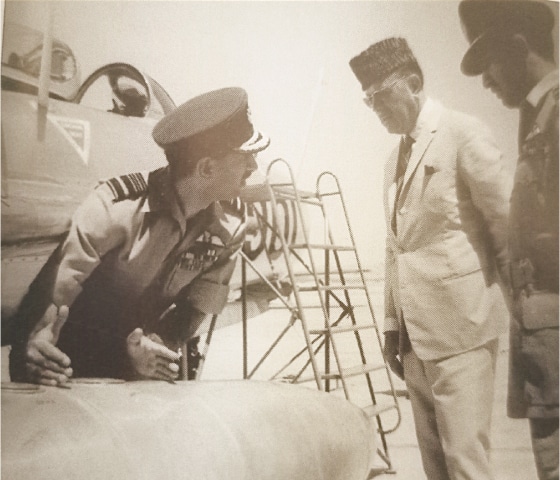
The RPAF found itself almost helpless in supporting ground forces in the first Kashmir war soon after Partition. It could only muster some supply missions, dropping supplies from the few Dakota aircraft it had, and that was it. The need to build up Pakistan’s military aviation capacity became apparent very soon.
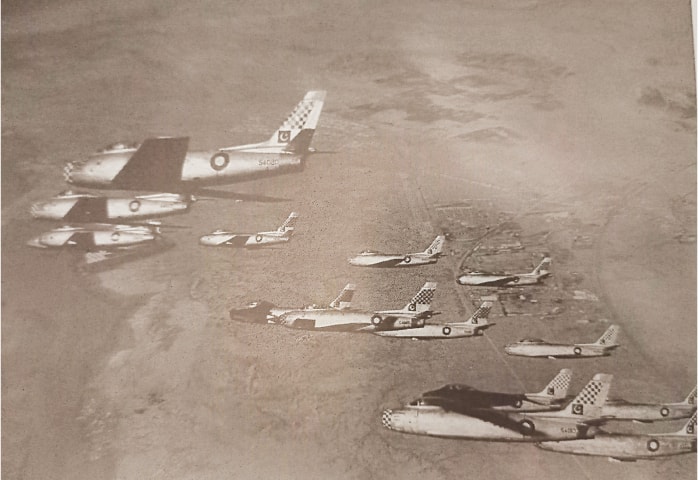
From 1948 to the early 1950s, the Pakistan government purchased a few old and rusted Tempest aircraft from the Royal Air Force in Singapore. They also placed an order with the RAF for 50 single-seat Fury aircraft and five dual-seater aircraft. In order to remain abreast with military aviation developments worldwide, the RPAF also started looking at acquiring jet fighters. Attackers, F-86 Sabres and F-104 Starfighters were inducted.
At the start of the 1965 war, the Pakistan Air Force (PAF) had a total of 119 F-86F Sabres, 12 F-104 A/B Starfighters and 24 B-57B Canberra aircraft in service. On September 6, 91 Sabres were in serviceable condition. As the war progressed, nine additional Sabres — which were off-line due to maintenance — were also brought back online. Twelve T-33s were also available, along with a handful of RT-33s for reconnaissance.
During the war, the PAF flew a total of 2,364 sorties and lost 20 aircraft. The IAF flew a total of 3,937 sorties and admitted the loss of 71 aircraft. The PAF heroes who gave their lives for the safety and sovereignty of their country at the time included squadron leaders Munir Ahmed, Sarfraz Ahmed Rafiqui, Alauddin Ahmed and Muhammad Iqbal, and flight lieutenants Yunus Hussain, Saifullah Khan and many more.
The biggest hero of the war was Air Commodore Muhammad Mahmood Alam, popularly known as M.M. Alam, who shot down five Indian jets in under a minute, a world record that remains unbroken, to return as a ghazi [survivor warrior]. The 1965 war made the PAF a darling of the country, a love affair that has continued.
By the time of the 1971 war, it was clear to all that the PAF was no longer that token force of 1947. Sadly, the book ends in 1971, leaving the reader on a cliffhanger, wanting to learn more about the next phase of PAF’s journey. But as the authors of this book mention in its conclusion, “the story of PAF from the end of 1971 onwards would see a different set of actors, difficulties and triumphs and is a story [that] deserves its own dedicated account.”
We also expect another book from them to take up from where they left off.
The reviewer is a business consultant. He can be reached at parabolicmirrorsontheroof@gmail.com
Published in Dawn, Books & Authors, September 7th, 2025