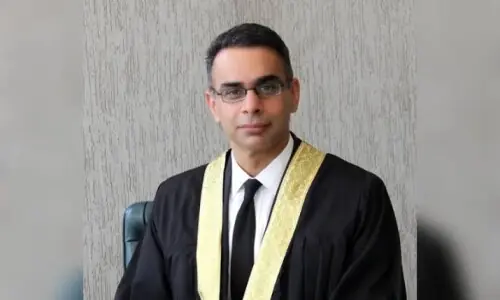
IT is difficult to disagree with the remarks of the Supreme Court’s Justice Athar Minallah, who on Thursday indicated that the hybrid system in Pakistan — where unelected powers are actively involved in civilian affairs — is a euphemism for dictatorship.
The veteran judge, while speaking in Karachi, also dwelt on the role the senior judiciary has played in the country’s history by endorsing the unconstitutional moves of strongmen.
Putting it bluntly, he said that the “77-year judicial history is not a matter of pride for me”, while giving examples of the Maulvi Tamizuddin case, as well as of Zulfikar Ali Bhutto’s trial and Gen Musharraf’s assaults on the constitutional order, to prove how at crucial times their lordships have sided with authoritarian rulers to subvert the rule of law. Mr Minallah also praised the bravery of judges who refused to bow before dictators.
Pakistan’s damaging experiments with different forms of hybridity, from earlier decades to the present day, have only weakened institutions, particularly parliament and the judiciary. And rarely have proponents of the hybrid system been held to account for their failures; the actual powers wash their hands of mistakes, while their civilian partners face the music. In contrast, in fully functioning democratic systems, elected leaders are held accountable before the voter.
Considering the judiciary’s role, as highlighted by Justice Minallah, in supporting unconstitutional moves — and these grim episodes are well-documented in our history — ‘willing’ collaborators on the bench have worked with usurpers to subvert the constitutional system, often guided by the ‘doctrine of necessity’. Sadly, in the current scenario too, many of their lordships have been perceived as coming to the aid of the real powers to give their legal blessings to doubtful laws and amendments.
The solution, as Justice Minallah suggested, is deceptively simple on paper, but difficult to put into practice: abiding by the Constitution, with all institutions staying within the bounds prescribed for them by the basic law. In this regard, when the country faces rampant insecurity, it is essential that the military sticks to its core duty of defending Pakistan. We face two major militant insurgencies — in KP and Balochistan — while a hostile neighbour to the east, and an unreliable regime in Kabul, mean we must constantly remain vigilant.
In such a situation, if the security apparatus indulges in political management, the focus on defence can become diluted. Whether it is direct military rule or a ‘hybrid’ system, both have left lasting scars on the constitutional system. Hence, there is a need to move away from the hybrid model in the interest of democracy, and in the interests of both the civilian and military leaderships.
Published in Dawn, September 6th, 2025