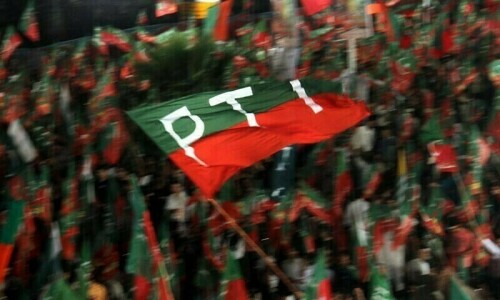
IT is again the season of boycotts. The PTI has decided to boycott the upcoming by-elections in all provinces except KP where it has its own provincial government.
The party founder Imran Khan, after sensing a sharp difference of opinion in the party leadership on the question, had asked the PTI’s political committee to deliberate and decide whether to contest or boycott the by-elections. The committee decided in favour of contesting elections with a majority of 12 versus eight votes but Imran Khan vetoed the political committee’s decision and, to give a face-saving opportunity, asked the committee to reconsider while personally calling for a boycott, leaving little choice to the committee except to go along with the founder’s decision. Besides the adverse impact of such boycotts, party decision-making also raises questions about the state of intra-party democracy and the place of senior party officials, not only in the PTI but most other parties as well.
The PTI has also decided to boycott the standing committees in the National Assembly and even resigned from the committees including the most important Public Accounts Committee though there was so much accountability the PTI could undertake through the PAC.
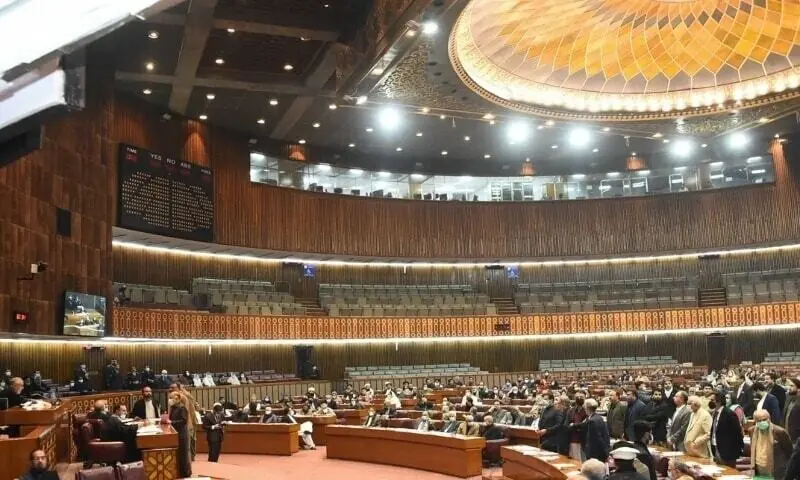
There have been numerous occasions when PTI legislators have boycotted the proceedings of their respective legislatures. Walkouts and occasional boycotts are normal democratic instruments of protest but these tools are used only symbolically without letting them interfere with parliamentary proceedings. In present-day Pakistan, however, such boycotts are more the norm than the exception.
It has also been reported that the PTI plans to boycott the National Assembly proceedings on almost a permanent basis, and instead, hold a parallel assembly outside the parliament building. It is apprehended that, in order to push the protest to a higher notch, it may once again opt to quit the assemblies, repeating the performance of 2022.
The PTI may have several genuine complaints about the conduct of the federal and provincial governments against which it is entitled to raise its voice and protest within the assemblies and outside. The party feels that it was robbed of the general election 2024 mandate, and therefore, does not recognise the current political dispensations both in the federation and the provinces, with the exception of the election and resulting government in KP.
One of its most serious complaints against the government is the prolonged imprisonment of some senior PTI leaders, including its founder Imran Khan who has recently completed two years behind bars. The second senior-most party leader Shah Mehmood Qureshi has also been incarcerated for about two years. In these circumstances, if the party decides to protest, one may not consider it unjustified.
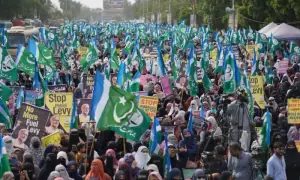
The problem, however, arises when street agitation impedes routine business and public movement, and carries the risk of violence. If the PTI provides assurance and complies with it that the agitation will not disturb educational and business life and public movement will not be hindered, it will only be appropriate to let it undertake public activities.
Traditionally, rival parties sat together in times of emergency. Not anymore, it seems.
Protest within parliament and provincial assemblies is also legitimate if it conforms to parliamentary norms, which sadly, is usually not the case whether it is by the PTI or other parties. Solemn occasions like the presentation of the annual budget by the finance minister and the address by the head of state at the start of the parliamentary year have traditionally been the most popular times for staging the loudest and messiest protests to attract maximum media attention.
But despite the polarisation and utter bitterness, opposing parties had been traditionally sitting together in times of extreme emergency such as war or a major calamity hitting the country. Not anymore, it seems.
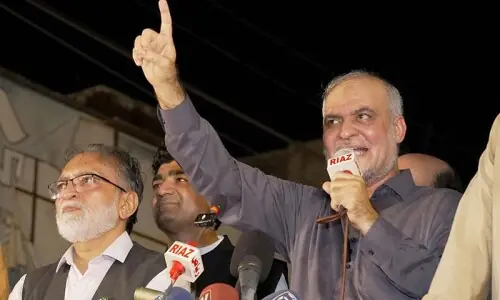
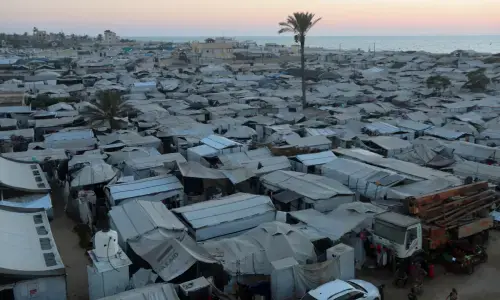
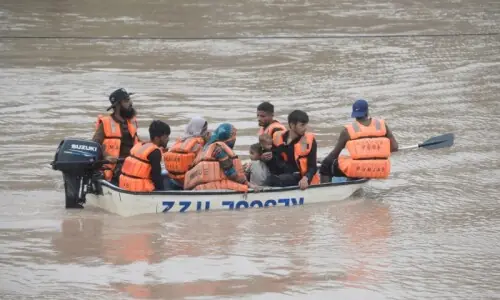
As the country faces calamitous super floods, which have already caused death and wide-scale destruction across the country and displaced millions from their homes, it was disturbing to see PTI parliamentarians boycotting the briefing by the chairman of the National Disaster Management Authority Lt-Gen Inam Haider Malik. This newspaper reported that the PTI chairman Gohar Ali Khan and senior party leader Asad Qaiser addressed a press conference and announced that they had decided not to attend the briefing on the orders of incarcerated party founder Imran Khan.
It was not clear what exactly prompted the boycott orders as only a few minutes earlier, both the government and opposition members in the National Assembly came together to express solidarity with the flood victims in a session dedicated to the debate on the flood catastrophe.
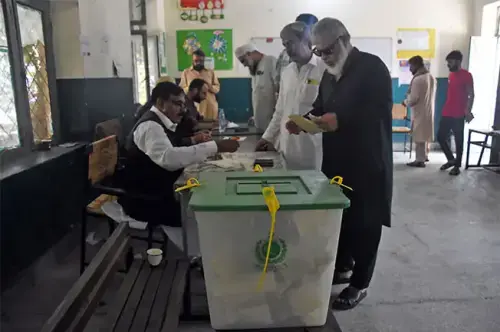
Experience has shown that the boycott of elections or assemblies by political parties is never a good idea. There are several avenues available for protest within the legislatures through speeches, questions, adjournment motions, calling-attention notices etc, and all these instruments ensure reasonable media coverage as well. Boycott will deprive the party of its due share of talk-time.
Benazir Bhutto always regretted the decision of boycotting the 1985 general election as it left the field open for pro-Zia parties who celebrated the absence of PPP-supported candidates in the non-party-based election. Although her party was defeated in the heavily rigged 1990 general election, she not only continued to lead her parliamentary party in the assembly but even accepted the chairmanship of the Foreign Relations Committee offered by arch-rival Nawaz Sharif. Despite the fact that PPP seats were drastically reduced from 89 in 1993 to merely 18 in the 1997 general election, which Benazir Bhutto vehemently disputed, she never boycotted the assembly.
The politics of boycott is certainly harmful for the country and its democracy but it is not even useful for a political party which adopts it as policy. It is hardly certain that the policy of boycott will help the PTI get its demands accepted but it is almost certain that it will damage the party and its candidates whose absence from the contest in the constituencies will weaken their position in the next election.
The writer is the president of Pakistan-based think tank, Pildat.
Published in Dawn, September 5th, 2025