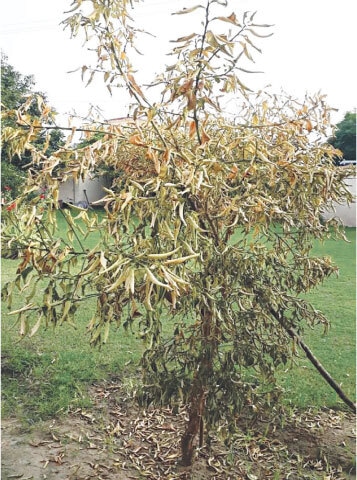
Q. I had planted a grapefruit sapling three years ago in Punjab’s Talagang and it has grown into a mature plant. Last year, it bore a couple of fully grown healthy fruits as well. This year, it was full of fruits and we were expecting a fine crop. A week or so ago, the tree suddenly started drying up, before its fruit could fully grow in size and ripen. Its leaves have suddenly gone pale, dropping in quick succession. Is it due to excessive rainfall during the monsoon season or any other reason? Its adjacent citrus plants are blooming with healthy fruit. It appears the plant will completely dry up soon and die. What can be done?
A. The sad news is that the tree, as seen in the provided photograph, is beyond saving. The only course of action is to pull out your plant and destroy it completely because it might be infected and may infect other surrounding citrus trees and plants. The soil should also not be used for gardening for a few months.
There can be a number of reasons for this sudden destruction of your grapefruit tree. But I would narrow it down to three highly likely reasons, based on the information you have shared. As you suggested, excessive monsoon rains, leading to waterlogging around the tree, could be one of them. The waterlogging may have destroyed the roots of the tree due to poor drainage.
Another reason could be that the sapling you purchased or received three years ago was already carrying the phytophthora fungus. When purchasing a sapling, ensure that you buy saplings only from a credible nursery.
All your gardening queries answered here
Thirdly, trunk-related issues, such as gummosis or collar rot attack, can also cause similar drying up of the tree and its branches. Check if there is any sticky substance oozing from the base of the trunk or if the trunk has darkened.
It must be heartbreaking for you to have invested three years into this plant for this to happen just as you were about to reap the rewards. Fortunately, you have other citrus trees around, so hopefully, your harvest this season will compensate for the loss.
![The brown patches on the leaves of the bela [Arabian Jasmine] plant could indicate several issues, including sunburn, fungal issues, lack of specific nutrients or overwatering | Photos courtesy the writer](https://i.dawn.com/primary/2025/08/68b1d563722ec.jpg)
Q. I am from Islamabad. My Japani phal tree is full of fruits. They are of a decent size but all the fruits are still green. Please advise on whether the fruit will ripen while attached to the tree or should the fruits be plucked, à la mangoes, and kept in a box wrapped in paper for ripening?
A. The Japani phal, or persimmon in English and amlok in Urdu, has a cult following, and its orange-coloured, sweet fruit is a favourite of many. Naturally, the fruit should be left on the tree to ripen. This allows the fruit to sweeten fully, but it also decreases its shelf-life once ripe. You may also harvest the fruit that is half-green and half-orange, or even completely-green, and let it ripen while wrapped in paper. The choice is yours and depends on your requirements.
Q. I am a resident of Karachi and an avid reader of your columns. I have a potted bela [Arabian jasmine] plant, which is several years old. In the last one month, its leaves have started to get brown, starting from the edges, and falling off. The production of the flowers has also declined. I regularly feed the soil eggshells and used tea leaves. What needs to be done so it can return to its old healthy condition?
A. The brown patches on the leaf could indicate several issues, including sunburn, fungal issues, a lack of specific nutrients or overwatering. If a fungal disease is suspected, the affected leaves should be removed. Place the pot at a location where there is enough aeration and exposure of early morning sunlight and away from direct late-afternoon sunlight. Spray it with neem oil. Check that the pot’s drainage hole is not clogged. Water the plant only when the upper soil surface turns dry. You can also use a balanced nitrogen, phosphorus and potassium (NPK) fertiliser every fortnight to replenish the soil’s nutrients.

Q. My uncle wants to send me a Japanese maple plant. I am circumspect though. Will it grow and thrive in Karachi?
A. The Japanese maple grows very well in colder regions. Very few of its varieties can tolerate Karachi’s temperatures and heat. I would suggest that you politely decline the offer, as it would be very difficult to maintain the plant’s health in Karachi’s climate.
Please send your queries and emails to doctree101@hotmail.com. The writer is a physician and a host for the YouTube channel ‘DocTree Gardening’ promoting organic kitchen gardening
Published in Dawn, EOS, August 31st, 2025