ISLAMABAD: A unique collection of ancient artefacts representing almost the entire heritage trail of the country has left for China to be part of a show in Beijing that is hosting the Shanghai Cooperation Organisation (SCO) 2025.
The exhibition, which will open at the National Museum of China, coincides with the Meeting of the Council of Heads of States of SCO, 2025, being held on August 31.
“Under the theme of ‘Respecting Diverse Civilisations, Pursuing Common Development’, the exhibition will invite national museums of SCO members to send representative objects to attend the exhibition. By doing so, the exhibition can display the diversity of culture, friendship and cooperation of the SCO family,” said a letter inviting the Department of Archaeology and Museums (DOAM) to participate.
Pakistan is among the nine full-member states, such as Russia, Kazakhstan, Uzbekistan, Kyrgyzstan and Iran, which are contributing artefacts for a show titled “Collections from Museums of Shanghai Cooperation Organisation Member States. Belarus officially joined the SCO in July 2024, making it the tenth member.
Relics include iconic Indus bull seal, astrolabe and several pieces depicting the Buddha
Pakistan is contributing ten artefacts dating from the late Neolithic period — Mehrgarh, down to Mohenjo Daro and all the way to the Islamic period, DOAM Director Dr Abdul Ghafoor Lone told Dawn.
The items include a stunning terracotta female figurine dating back to 3,000-3,500 BCE from the Neolithic period and a 2,800-2,700 BCE painted globular pot.
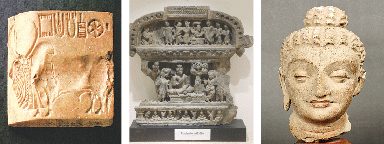
The 5,000 BCE Steatite Indus Seal with a humped bull and inscription is the oldest relic to be put on display at the exhibition. The 1,600-1,800 BCE terracotta horse figurine and the Jain ritual tank adorned with birds and lamps, which dates back to 600-200 BCE, will also be put on display.
The most interesting piece, perhaps, is the stone panel depicting Apalala Jataka, 3-4 Century BCE. The relic shows Buddha commanding Naga Apalala, a water-dwelling Naga in Buddhist mythology, to stop flooding the Swat River and the valley. It is said that Apalala lived near the Swat River.
Besides the 3rd to 4th Century CE Buddha head, also on display will be the 19th Century CE Astrolabe used by sailors. In its simplest form, it’s a metal disc with perforations that allowed sailors to calculate astronomical positions precisely.
Published in Dawn, August 25th, 2025