IT WAS a bright morning when I set out from Gilgit towards Sost, a town perched near the Khunjerab Pass on the Karakoram Highway (KKH), on the nation’s Independence Day.
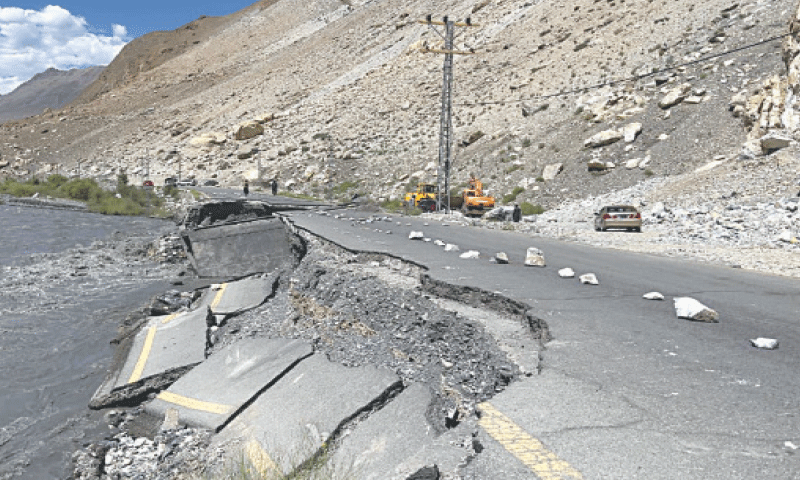
The sky was a flawless blue, but the land bore fresh wounds: roads torn apart like paper, fields drowned beneath silt-laden water, bridges twisted and broken.
The KKH, a lifeline for the region, runs alongside the Hunza-Nagar river. But here, swollen waters had swallowed farmland and trees, in places spilling into homes across the Gilgit, Hunza and Nagar districts. Elsewhere, too, the landscape was a tableau of devastation.
You see, in Gilgit-Baltistan, death doesn’t announce itself. Even under spotless skies, clouds can gather around high peaks within minutes, unleashing furious rain and birthing floods that race down valleys.
The water changes its mind in an instant, giving people no time to escape, grab their belongings, or even hold onto each other.
As climatic disasters riddle the region, Dawn’s Gilgit correspondent recounts his own precarious journey from Sost to his hometown
When heatwaves grip the mountains, glacial lakes burst, sending walls of water thundering through sleeping villages.
Despite the mounting risks, no scientific studies have mapped these glaciers’ behaviour, and no functional early warning systems are looking out for vulnerable areas.
I reached Sost by threading through the Sas Valley — the main road had been eaten by a Glacial Lake Outburst Flood (Glof) from the Shishper glacier just days before.
The town greeted me with no electricity. The Khunjerab River had damaged transmission lines and a sudden flashflood from had blocked the KKH at Gulmit, an area I had just crossed.
Internet and mobile networks were down — the flood had severed the optic fibre cable connecting GB to the outside world.
As a journalist, the complete communication and electricity blackout made me nervous. I needed to file my story, but we were marooned. In our desperation, we drove to Misgar village, climbing higher as we searched for a signal, but found nothing.
By now, there was no way back to Aliabad, the district headquarters of Hunza.
At my hotel in Sost, a young waiter from Chipurson valley — a mere 40km away under normal circumstances — told me he hadn’t heard his family’s voice for a week.
“The road to Chipurson valley was eroded by the river a week ago, and mobile communication in my village is disconnected,” he said.
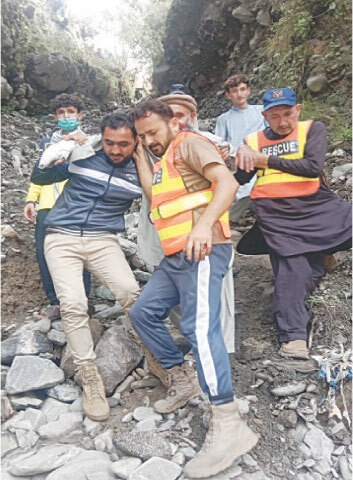
We returned to the blockade at Gulmit. Thousands of passengers, including those travelling to or from China via the Khunjerab Pass, were stranded on both sides, waiting for the road to reopen. The only way across was on foot, through the flooded zone, with the help of local volunteers.
There I met Saeed Jan, still trembling from what he’d witnessed. “Twenty floods in just hours,” he said. “Sweeping away everything in their path.”
I managed to cross the blockade and found a vehicle to take me towards Aliabad. But before the KKH could be fully restored, another wave of floodwaters roared down the mountain, halting work and making the passage impassable once again.
To help the stranded, locals started a boat service across Attabad Lake, where the flooded nullah now drains.
In Passu, families from Shimshal Valley sat on the roadside like refugees in their own land. Their village—Hunza’s last outpost — has been cut off from the world for a week as floods and river erosion destroyed its access road in multiple locations.
When I finally reached Aliabad, my hopes crumbled. There was no internet or phone service, and a Glof in Hassanabad had, once again, disconnected the optic fibre cable.
Here, a newly constructed bridge on the KKH was closed. It was dark, and volunteers blocked the path forward. The only sound was the roaring flow of glacier water. Everyone was in shock, uncertain about which way the glacier would turn.
“The uncertainty of Shishper glacier’s behaviour puts local residents at risk,” one said.
My own journey home to Nagar Khas felt perilous. Rocks pounded the road like bombs. The river lapped at what remained of the road, as if tasting it before deciding whether to swallow it whole.
In my village of Tokorkot, I found my neighbours fleeing as the Hoper nullah unleashed its fury.
“The flood intensity was too heavy. I have never experienced it in my life,” said Niyat Ali, 75, pointing towards the nullah. “In our times, floods occurred under special circumstances, either continued heatwaves or heavy rains, once or twice.”
August 14 was the most disastrous day for the region, particularly for Ghizer residents, as cloudbursts induced floods in 40 locations in a single day, killing ten people and destroying dozens of homes, bridges and roads.
“The devastation was sudden. People have no way to flee,” said Naeem Anwar, a resident of Ghizer. “Local residents have never experienced such horrific devastation.”
The geography that once blessed this region — dramatic peaks and pristine valleys — has now become a curse. The KKH lifeline lies broken in too many places to count. The Baltistan Highway and Ghizer-Shandoor road are also damaged, leaving much of the population stranded.
The local government, meanwhile, seems overwhelmed by the scale of the disaster.
“We don’t have resources,” GB Home Minister Shams Lone confessed.
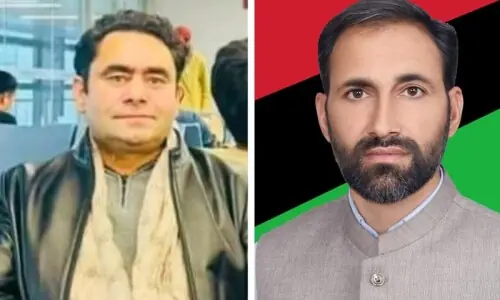
Even volunteers who rushed to help became part of the tragedy; nine died trying to restore what nature had undone—two on the Fairy Meadows road, and seven repairing a water channel in Danyore.
The over 8,000 glaciers of GB, which once supported around 70pc of Pakistan’s agriculture, are now rapidly melting.
If this is just the beginning, I shudder to imagine what the endgame may look like.
Published in Dawn, August 18th, 2025