

Recently brought to life at Ithaque Gallery in Paris and curated by Abi Tariq, ‘The Wedding Album’ is the latest chapter of Shy Bride Video Services, a performative wedding photo and videography project conceived by artists Zahra Mansoor and Juliet Lazek.
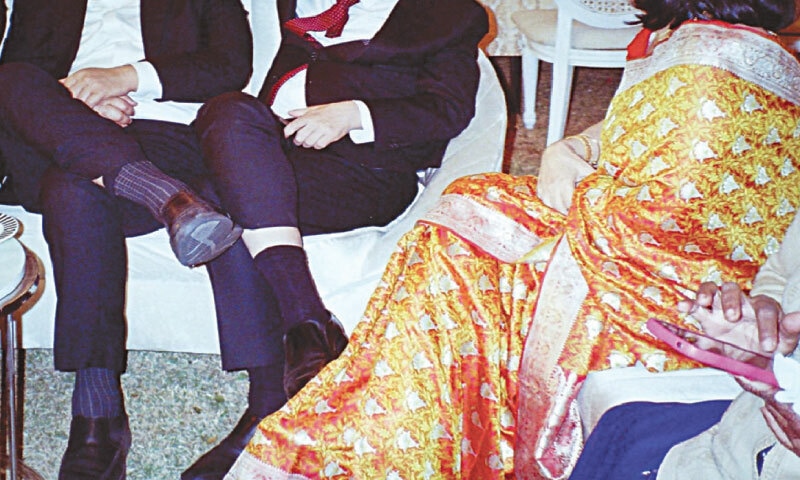
From the conception of the idea, to its execution and final delivery of the project, ‘The Wedding Album’ is one of those rare art forms whose layers continue to reveal themselves with time and observation. On a purely aesthetic level, one sees saturated, kitsch, cropped scenes from South Asian weddings — the kinds often represented in Bollywood movies, a digestible and highly recognisable visual language, almost as if taken from a collective memory.
But the heart of the project lies in its process. Over the course of five separate weddings in Karachi, Mansoor and Lazek toy with the line between research and art by enacting a method performance through the perspective of Shy Bride’s “videography services.” Semi-anthropological, their work ultimately reveals the performative nature of weddings, where individuals enact, rehearse and reinforce their societal roles.
From intricate guest lists and lavish displays of flowers and decoration to copious amounts of food and alcohol and heavily embroidered dresses, the wedding is a crucible for socio-economic status signalling, and the marriage an institution in which it is enshrined and preserved. “Marriage is a part of the performance of life,” notes Mansoor. “The wedding brings together the public and private performance, and this social game evolves into a third space. When the wedding is over, this performance becomes private.”
An exhibition in Paris turns the lens on South Asian weddings and posits them as carefully choreographed performances that reveal social standing, economic status and tradition
Using the institution of marriage as a vehicle to question class and gender structures, each image becomes a multifaceted representation of a deeper phenomenon. One of them is the location of the wedding which, for the elite, often takes place at private clubs or government buildings. These places reinforce dated notions of patriarchy and economic barriers to entry, embodying the exclusive and unattainable.
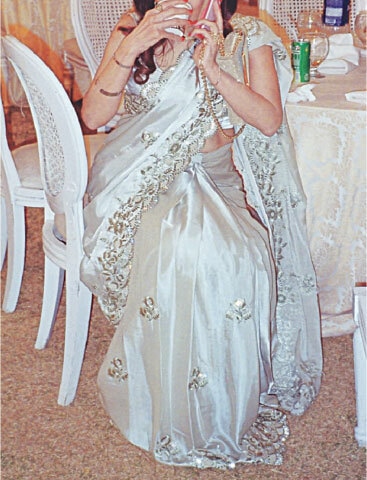
The gallery also perfectly lends itself to the exhibition. Alexandre Arminjon, the founder of Ithaque Gallery, has a palpable interest in the Middle East and a passion for the craft of photography. The darkroom at the back of the space is where he personally hand-printed the analogue black-and-white images, which were displayed in the middle room.
This room is smaller and marked by a large printing machine at its centre, separated by a thick black curtain that evokes the sense of a theatre stage opening and closing. Here, the images on display are elegant and thought-provoking. The printing on velvet paper renders the subject matter and technique more refined and restrained.
With a hands-on approach, one of the focal points of the exhibition is the beautifully coloured velvet frames that adorn the walls and surround a selection of images. These are an ode to traditional velvet-bound wedding albums which, while immortalising memories, often gather dust and become symbols of the heavy passage of time. The Shy Bride project reclaims this object, using it as a frame to re-contextualise and question the very memories it preserves.
‘The Wedding Album’ is a subtle act of resistance. It is a tender, satirical observation of an institution that touches every part of public and private life in South Asia.
‘The Wedding Album’ was on display at Ithaque Gallery in Paris from July 3-22, 2025
The reviewer is a writer and cultural strategist based between Paris and London. She is the founder of TAARA Mag, an independent platform exploring art, identity and storytelling across South Asia and its diaspora
Published in Dawn, EOS, August 17th, 2025