China debuts mosquito-sized spy drone
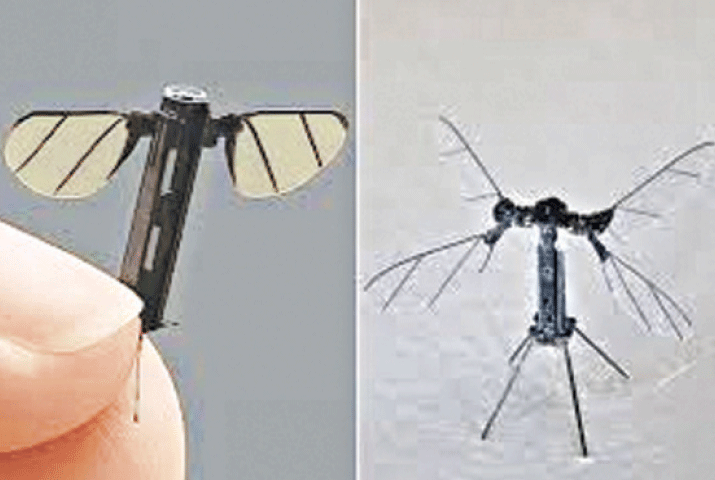
China’s National University of Defence Technology has developed a surveillance drone so tiny it’s nearly indistinguishable from an insect. Measuring just 1.3 cm with flapping, leaf-like wings and hair-thin legs, the device can slip into hidden spaces undetected.
Controlled by smartphone, the ultra-quiet drone is intended for military reconnaissance but could also be used for disaster response or air quality monitoring by carrying miniature sensors. Despite its viral popularity on Chinese social media, it faces limits — short battery life and restricted sensor capacity due to its size.
Doctors remove live eel from man’s abdomen
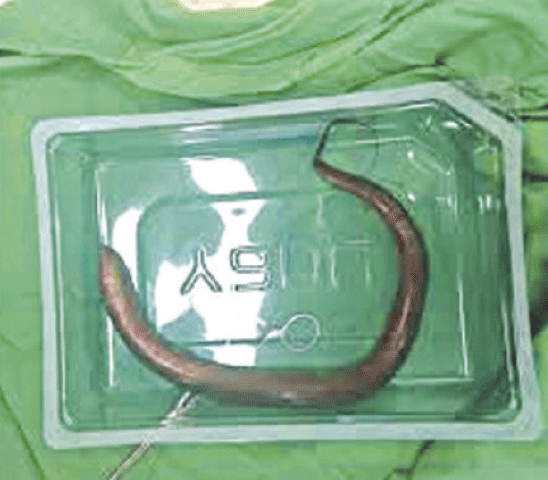
A 33-year-old man in Hunan, China, underwent emergency surgery after arriving at the First Affiliated Hospital of Hunan Medical University with severe abdominal pain and heavy sweating. A CT scan revealed a foreign object had pierced his stomach and entered his abdominal cavity.
Surgeons were stunned to find a live eel swimming among his organs. It had burrowed through the intestinal wall, risking a life-threatening infection. The eel was removed with a clamp, the damaged colon repaired, and the area flushed with saline. The patient recovered and was discharged. How the eel entered remains a mystery.
Dinosaur fossil found beneath museum parking lot
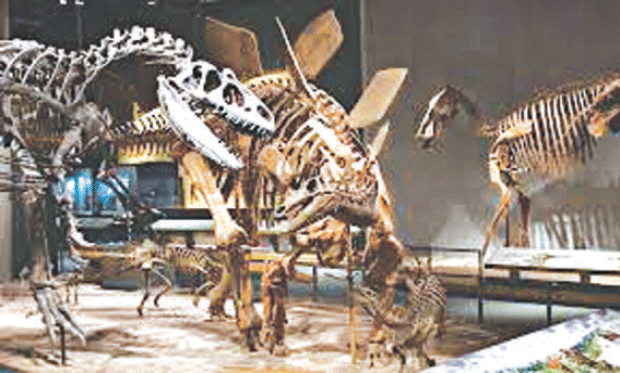
The Denver Museum of Nature and Science has made an extraordinary discovery — a dinosaur fossil right under its own parking lot. While drilling 750 feet deep to study geothermal energy, a bore just two inches wide struck a rare vertebra, likely from a small, plant-eating dinosaur that lived 67.5 million years ago in a swampy environment. Fossilised vegetation was also uncovered, which provide a glimpse into Denver’s ancient swampy environment during the Late Cretaceous period.
“This is like hitting a hole in one from the moon,” said James Hagadorn, the museum’s geology curator. Only two similar fossil finds through bore holes have ever been recorded worldwide. The vertebra may belong to a duck-billed dinosaur or thescelosaurus. It’s now on display, but no further digging is planned — the parking spaces stay.
Sweden’s cheese-coffee tradition gains EU status
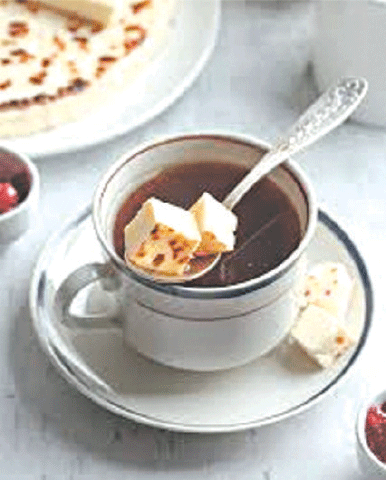
In northern Sweden, coffee sometimes comes with a cheesy twist. Known as kaffeost, the drink combines hot coffee with cubes of leipäjuusto or “bread cheese” — a sweet, spongy variety that softens while soaking up the coffee’s flavour.
This tradition, rooted in Sami reindeer herders’ diets in Sweden and Finland, once served as a way to combat sodium deficiency and stay energised in cold climates. Today, cafes offer versions made from reindeer, cow, or goat milk cheese.
Published in Dawn, Young World, August 16th, 2025