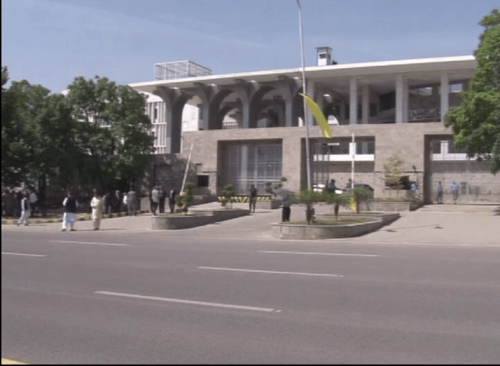
• Federal Constitutional Court initially proposed in 26th Amendment back on anvil
• Changes to transfer, seniority criteria of superior judges under discussion
EVEN though the 26th Amendment is still mired in controversy, the power corridors in Islamabad are abuzz with talk of a possible 27th Constitutional Amendment, which, according to the insiders, will further “fine-tune” the structure and the functioning of the superior judiciary.
With the 26th Amendment, the government introduced sweeping changes to the judicial framework: it abolished the exclusive reliance on seniority as the criterion for appointing the Chief Justice of Pakistan, mandated the establishment of constitutional benches to hear petitions under Articles 184(3) and 199 of the Constitution, and reconstituted the Judicial Commission of Pakistan (JCP) for the appointment and confirmation of judges, among other changes.
Sources said certain contentious matters, such as a separate constitutional court, left unresolved in the 26th Amendment, would now be taken up in the new amendment.
Though the speculations are rife, there has been no official word regarding the 27th constitutional amendment. At present, the proposal to further reform the judiciary is at very initial stages, but consultations are reportedly underway within the ruling PML-N and some legal circles. Despite these purported consultations, any draft for this proposed bill has yet to see the light of day.
The idea of the federal constitutional court is rooted in the Charter of Democracy signed between the PML-N and the PPP on May 14, 2006, in London. The agreement outlined a comprehensive framework to end the military rule imposed after the 1999 coup led by military dictator Pervez Musharraf and emphasised political reconciliation, the elimination of political victimisation, and free and fair elections, judicial independence, and parliamentary supremacy.
At the time of the 26th Amendment, passed last year, the ruling coalition led by the PML-N and the PPP intended to establish the Federal Constitutional Court, but the plan could not materialise for lack of a two-thirds majority in parliament. The coalition, deprived of reserved seats due to a Supreme Court ruling, had required the support of Maulana Fazlur Rehman’s JUI-F. The latter opposed a separate court and instead endorsed a constitutional bench.
Now that the government has clinched the two-thirds majority after the reserved seats order by the constitutional bench, sources indicate that the FCC will be a centrepiece of the 27th Amendment. For this purpose, Article 175 of the Constitution, which currently provides for the Supreme Court, a high court for each province, and a high court for the Islamabad Capital Territory, would be amended to insert the Federal Constitutional Court immediately after the mention of the Supreme Court.
Transfer and seniority
The proposed amendment is also expected to address the lingering question of inter se seniority among judges, an issue that recently sparked controversy within the Islamabad High Court. The ‘constitutional package’ may include the creation of a dedicated “judicial cadre” to regulate the transfer of judges between high courts and eliminate ambiguity over seniority rankings. The seniority list of all the judges of the high court would be maintained and the seniority would be determined by the date of appointment and the age of the judge.
The amendment may also include a proposal for upward revision in the retirement age of the superior court judges. As per Article 179 of the Constitution, the superannuation age of the Supreme Court judge is 65 years, while a judge of a high court retires at the age of 62.
Another key provision under review is Article 200, which governs the transfer of high court judges. At present, such a transfer requires the judge’s consent as well as consultations between the president, the Chief Justice of Pakistan, and the chief justices of the high courts involved. The proposed change would remove the requirement of “consent” and could vest transfer authority in the JCP. This reform was included in the draft bill of the 26th Amendment but was excluded from its final version.
In a comment on this proposed transfer system, a high court judge said that such an amendment would create uncertainty among the judges, as no one would know who would end up being a junior judge in case of reshuffling.
Recently, Islamabad High Court Bar Association President Syed Wajid Ali Shah Gillani demanded the transfer of judges, both in the high court and lower courts, from Islamabad to other provinces for transparency and exposure.
Published in Dawn, August 11th, 2025