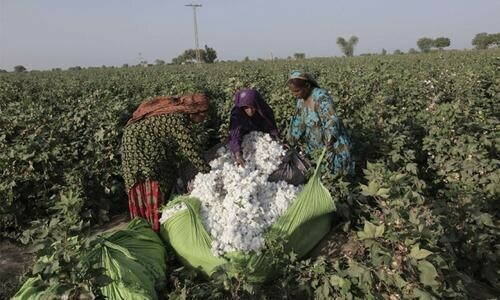
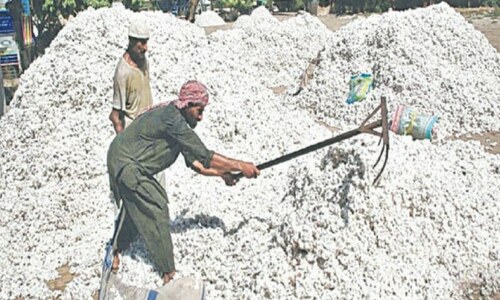
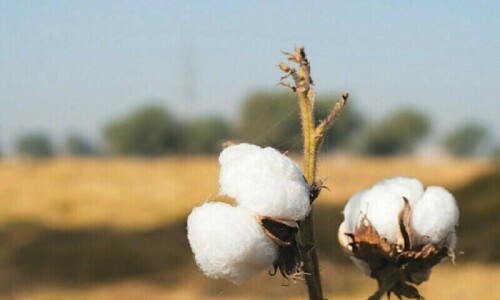
LAHORE: Pakistan has experienced a 30 per cent decrease in its overall cotton production compared to the same period last year, with only 594,000 bales of raw cotton reaching ginning factories nationwide by July 31, reveals the data released by the Pakistan Cotton Ginners Association (PCGA) on Sunday.
This sharp decline is primarily driven by a record 47pc drop in Sindh’s output. Surprisingly, Punjab has managed a slight increase in production, according to the PCGA data.
The PCGA report indicates that ginning factories in Punjab received 302,000 bales by July 31, a modest 3pc increase over the previous year. In stark contrast, Sindh’s ginning factories processed only 292,000 bales during the same period, marking a significant 47pc reduction.
Adding to the complexity is a striking discrepancy between the PCGA data and figures released by the Crop Reporting Service of the Punjab Agriculture Department.
While PCGA reported 301,000 bales of raw cotton arriving at Punjab’s ginning factories, the CRS stated that the province produced 609,000 bales during the same period – an astonishing 100pc more than the PCGA figures.
Despite the overall decline, 99,000 bales from the current year’s produce are still available for sale in ginning factories, compared to 64,700 bales last year. Textile mills have purchased 529,000 bales from ginning factories during this period.
This year, 114 ginning factories are operational in Punjab and 154 in Sindh, a shift from last year’s figures of 120 in Punjab and 105 in Sindh.
The higher volume of cotton arriving at Punjab’s ginning factories, despite Sindh’s larger number of active factories, is attributed to a significant portion of cotton from Sindh and Balochistan being diverted to Punjab due to better prices, says Cotton Ginners Forum Chairman Ihsan-ul-Haq.
However, the industry faces growing concerns. Haq says that recent heavy rains have adversely affected the quality of cotton, subsequently impacting the quality of lint.
This has led to a lack of interest from textile mill owners in purchasing lint, causing substantial losses to ginning factory owners, he adds. As a result, ginning factories in several cities across Punjab and Sindh are beginning to cease operations, which could lead to a downward trend in cotton prices, he cautions.
As a countermeasure, the PCGA has imposed a cotton moisture policy in view of the more than normal rains in the cotton belt.
A letter issued by PCGA Secretary General Zikrullah Khalidi last Thursday says that under the new moisture policy effective from August 1, the ginners would pay full rate to the growers without any deduction (allowance) in the weight in case of up to 10pc moisture in their produce.
In case of 11 to 40pc moisture, a deduction (allowance) of 100 grams will be made, while the produce having over and above 40pc moisture will be rejected, the letter adds.
Published in Dawn, August 4th, 2025