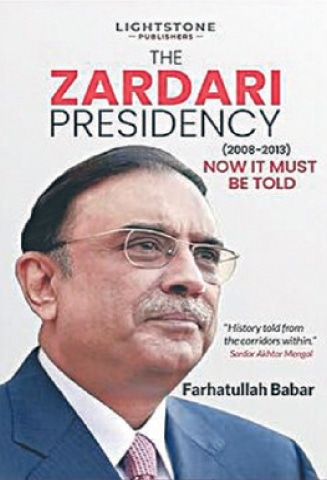
The Zardari Presidency (2008–2013): Now It Must Be Told
By Farhatullah Babar
Lightstone Publishers
ISBN: 978-969-716-304-5
462pp.
As the only individual elected twice as the President of Pakistan, Asif Ali Zardari defied immense odds. Undoubtedly, he is a master of political survival — navigating battles against both political and non-political forces, including the judiciary and the deep state.
Before his marriage to Benazir Bhutto in 1987, Zardari was a relatively unknown figure. However, his prominence soared following their union. In this remarkable book, The Zardari Presidency (2008–2013): Now It Must Be Told, Farhatullah Babar describes him as “possessing the courage to live in his wife’s shadow, unruffled and at peace.”
Babar recounts how Zardari, on several occasions, held the Pakistan Peoples Party (PPP) together by emphasising his connection to the Bhutto family. After Benazir’s assassination, he allowed his children to adopt the Bhutto name, led the party to electoral victory and guided the government through an extraordinarily turbulent period.
In the book, Babar unveils the tumultuous nature of Zardari’s presidency, making startling revelations about how the deep state repeatedly acted — borrowing the words of then Prime Minister Yousuf Raza Gilani — as “a state within the state.”
An insider account of the high-stakes political drama that marked the first term of one of Pakistan’s most controversial civilian leaders
This is not a typical political memoir, a genre often used in Pakistan to whitewash the author’s own role while exposing others. Many such accounts, by civil or military bureaucrats, seek to absolve the authors of responsibility or serve as extended eulogies for their patrons. Farhatullah Babar’s book, however, stands out as one of the finest of its kind, offering a fairly balanced perspective on a crucial period in Pakistan’s history.
Although the title suggests coverage limited to the years 2008–2013, the book’s scope spans almost two decades of 21st-century Pakistan. Having been an insider in the PPP for nearly 40 years, Babar is uniquely positioned to “spill the beans.” As a senior journalist and accomplished writer, his narrative is fluid, transitioning seamlessly from one crisis to another.
Babar admits that he was not close to Zardari in the early years but, over time, mutual trust deepened, eventually leading Zardari to appoint him as his aide. The book is filled with high-stakes political drama, much of it unfolding within the walls of the presidency. While shadowy forces prepared to strike, Zardari had little time to respond or plan. Yet, he consistently emerged on top in these power struggles — battles that were imposed not just on him but on Pakistan’s fragile democracy as a whole.
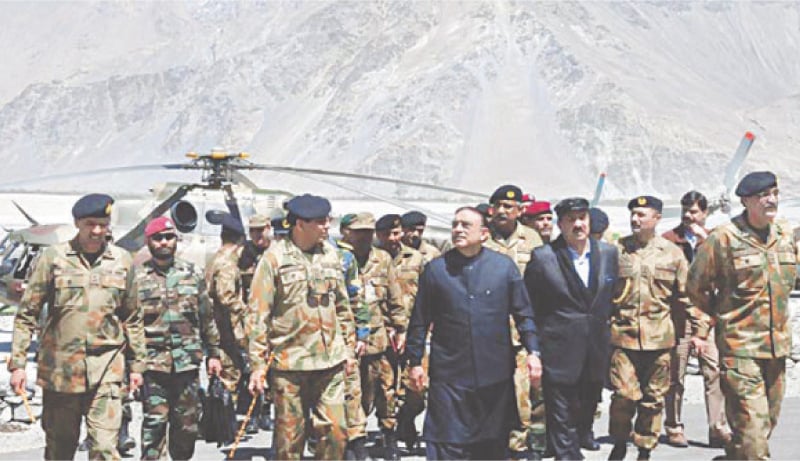
The seismic events Babar recounts are not new to Pakistan, but his perspective is. The corridors of the presidency are not open to all, yet they were never closed to the deep state. The image of soldiers pacing the grounds of the presidency at night is chilling, prompting the reader to wonder whether any civilian president — or prime minister — can ever feel truly secure in what is supposedly the highest constitutional office.
In gripping detail, Babar describes how the halls of parliament were transformed into arenas of conspiracy, as the deep state moved its pawns into place. The mysterious election of Sadiq Sanjrani as Senate chairman and the evident involvement of high-ranking members of the security establishment is enough to provoke dismay, if not outright disgust. The establishment, the judiciary — particularly under Chief Justice Iftikhar Chaudhry — and mainstream media often seemed to conspire in a relentless campaign against Zardari and his government.
It remains paradoxical that, despite coordinated efforts by the military, judiciary and media to undermine him, Zardari frequently prevailed — with his trademark smile intact. In Babar’s words, Zardari was, and remains, a pragmatic leader — pragmatic in a context marked by betrayal and subversion from state entities that should have supported him as the constitutionally mandated ‘supreme commander.’ Instead, these institutions worked to erode the very authority they were meant to respect.
The book makes it painfully clear how deeply entrenched the interests of Pakistan’s most powerful institutions are — so much so that no political government seems likely to reclaim its constitutional authority anytime soon. Babar details how the PPP’s political allies wavered with each successive crisis. From the US operation that captured Osama bin Laden in Abbottabad to the manufactured drama of the Memogate affair, the deep state’s efforts to cover its own failures were shameless.
Despite facing enormous resistance and having multiple guns metaphorically trained on him, Zardari kept Pakistan’s democracy afloat. His ability to lead the country — and the PPP — speaks volumes about his resilience. The book offers compelling evidence portraying Zardari as a figure who, though often mentally and physically drained, repeatedly rose like a phoenix, earning admiration from both allies and opponents.
Diplomatic dealings with figures such as Hillary Clinton and John Kerry were no less challenging. These American officials frequently altered plans at will, often displaying a lack of courtesy. Babar is blunt in recounting the deep state’s consistent mistrust of civilian leadership. Nevertheless, Zardari succeeded in pushing through historic reforms — most notably the 18th Constitutional Amendment. Babar does not depict Zardari as an untarnished hero but presents a nuanced figure, praising his strengths while acknowledging his missteps.
It remains paradoxical that, despite coordinated efforts by the military, judiciary and media to undermine him, Zardari frequently prevailed — with his trademark smile intact. In Babar’s words, Zardari was, and remains, a pragmatic leader — pragmatic in a context marked by betrayal and subversion from state entities that should have supported him as the constitutionally mandated ‘supreme commander.’ Instead, these institutions worked to erode the very authority they were meant to respect.
The deep state may have been unrelenting, but Zardari succeeded in rewriting some of the unwritten rules of power. One of the book’s strongest features is its rich collection of personal and insightful anecdotes, which keep the reader engaged. These stories illuminate the untold dimensions of Pakistan’s political history, making the book — if we may borrow the phrase — a treasure trove for historians and students alike.
As Afrasiab Khattak aptly writes in his blurb:
“…the deep state breathing down the president’s neck, the cat-and-mouse games played, the judges obsessed with power and upending democratic structures, troops of the 111 Brigade thudding into the presidency at night to browbeat a defiant Zardari, a half-baked overture for peace with India falling apart, scapegoating a civilian president for the discovery of Osama bin Laden in a military cantonment, pushing Zardari to the brink — and a captivating account of Zardari’s personal traits and paradoxes — makes it unputdownable.”
The reviewer is a columnist and educator. He can be contacted at mnazir1964@yahoo.co.uk.
Published in Dawn, Books & Authors, July 27th, 2025