Pakistan ready for ‘meaningful dialogue’ with India, PM Shehbaz reiterates in talks with UK envoy


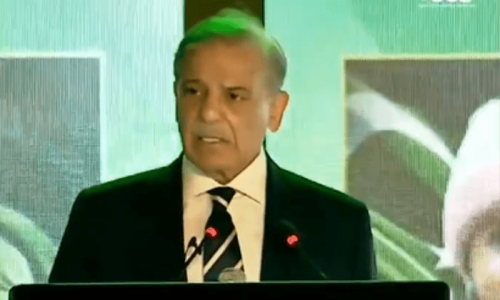
Prime Minister Shehbaz Sharif on Wednesday reiterated Pakistan’s willingness for a “meaningful dialogue” with India on all outstanding issues, state media Radio Pakistan reported.
The April 22 attack in occupied Kashmir’s Pahalgam killed 26 people, sparking a military confrontation between nuclear-armed India and Pakistan as New Delhi blamed it on Islamabad, which strongly denied the allegations while calling for a neutral investigation. A US-brokered ceasefire ended the war.
Pakistan previously invited India to a comprehensive dialogue to address all contentious issues, including the Kashmir dispute and the water distribution.
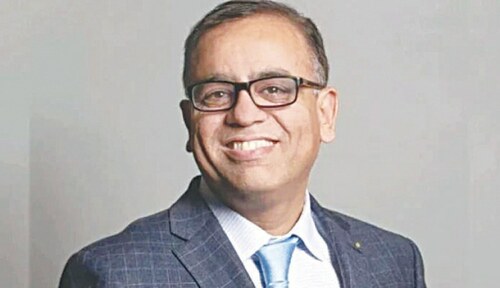
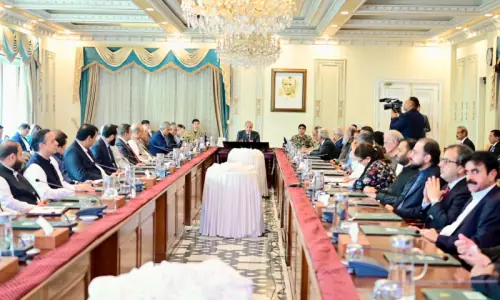
During a meeting with British High Commissioner Jane Marriott today, PM Shehbaz appreciated the UK’s role in de-escalating tensions during the Pakistan-India standoff and reiterated that Pakistan was ready for a meaningful dialogue with India on all outstanding issues.
He welcomed the British government’s decision to resume PIA flights to the UK. He said, “This [decision] would go a long way in alleviating the hardships faced by the British-Pakistani community as well as enhancing people-to-people exchanges,” while appreciating the role of the high commissioner.
Both sides discussed the “positive trajectory” of bilateral relations. The prime minister said that the recently held trade talks between the two countries would lead to mutually beneficial opportunities for both sides. “Pakistan is also cooperating closely with the UK at the UN Security Council, where Pakistan currently holds the monthly Presidency,” he said.
Marriott briefed PM Shehbaz about her recent visit to London, where she had extensive consultations on enhancing bilateral ties.
She lauded the Pakistani government’s recent economic performance which brought about a significant improvement in key macroeconomic indicators. She also discussed the UK’s perspective on regional developments in South Asia and the Middle East.
Last week, UK’s government launched e-visas for Pakistani students and workers as part of an “enhanced” border and immigration system.
The announcement came just a day after the two countries formally signed the Trade Dialogue Mechanism Agreement and decided to establish the UK-Pakistan Business Advisory Council to institutionalise bilateral economic cooperation.
UN envoy hits back at India for cross-border terrorism claims
Meanwhile, Pakistan’s envoy to the UNSC, Ambassador Usman Jadoon, rejected Indian allegations of cross-border terrorism and asked India to change its behaviour, instead of resorting to its “tired narrative of victimhood and blame-shifting”, during the UNSC debate on “Promoting International Peace and Security through Multilateralism and Peaceful Settlement of Disputes” on Tuesday.
The Indian envoy was reacting to Deputy PM Dar’s speech in New York during the reception hosted for Pakistan’s presidency of the UNSC, where the latter underscored the need for the resolution of the Kashmir dispute.
“It is India which actively sponsors, aids and abets terrorism in my country and beyond,” Ambassador Jadoon, deputy permanent representative of Pakistan to the UN, told the 15-member body on Tuesday evening, while responding to allegations made by India’s UN Ambassador Parvathaneni Harish.
“Rather than being blinded by hubris and a misplaced sense of impunity, and instead of resorting to its tired narrative of victimhood and blame-shifting, India must introspect seriously, change its behaviour and comply with its international legal obligations on all counts,” he said, in the debate convened by Pakistan to promote pacific settlement of disputes between nations.
Ambassador Jadoon said that it was especially regrettable that the Indian ambassador targeted Pakistan yesterday, when earlier in the day, the council “spoke with a unanimous voice to reaffirm the purposes and principles of the UN charter and the imperative of peaceful settlement of disputes, respect for international law and effective implementation of the resolution of the security council”.
The Pakistani envoy pointed out that firstly, India was in illegal occupation of the disputed territory of Jammu and Kashmir.
“While claiming to abide by the UN charter, and purportedly the principle of peaceful settlement of disputes, India has been in violation of security council resolutions on the Jammu and Kashmir dispute, and has refused to implement those resolutions, thereby denying the Kashmiri people the exercise of their inalienable right to self-determination,” he said.
“India’s egregious violations of human rights which extend beyond the occupied territory of Jammu and Kashmir and encompass its appalling treatment of minorities has been widely reported by international human rights organisations,” Jadoon added.
He also said that India had “stooped to a new low” of unilaterally and illegally holding in abeyance the 1960 Indus Waters Treaty, with the stated aim of depriving the people of Pakistan of water from the Indus river system.
“In gross violation of international law, India resorted to blatant aggression against my country between 7-10 May, targeting civilians, including women and children,” the ambassador said.
He highlighted Pakistan’s “befitting but measured response” in accordance with its right to self-defence, aimed exclusively at military targets, that resulted in the downing of six Indian aircraft that took part in the aggression, among other significant military losses.
“The hostilities came to an end owing to Pakistan’s position of strength and responsible approach, and facilitation of the US, as also highlighted in the statement of the US this morning, “ Jadoon told the delegates.
“It is ironic that India, which itself brought the Jammu and Kashmir dispute to the security council, refuses to implement the resolutions adopted by the council to peacefully resolve this dispute,” he added.
Obviously stung by the success of Pakistan’s signature event at the council, the Indian envoy had claimed that Pakistan was “steeped in fanaticism and terrorism”, and a “serial borrower from the International Monetary Fund”.
The debate will resume on July 24 to listen to the remaining speakers, after listening to scores of high-level representatives.