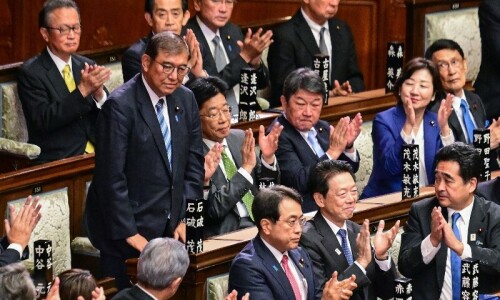
Japan PM insists on staying at helm after poll drubbing
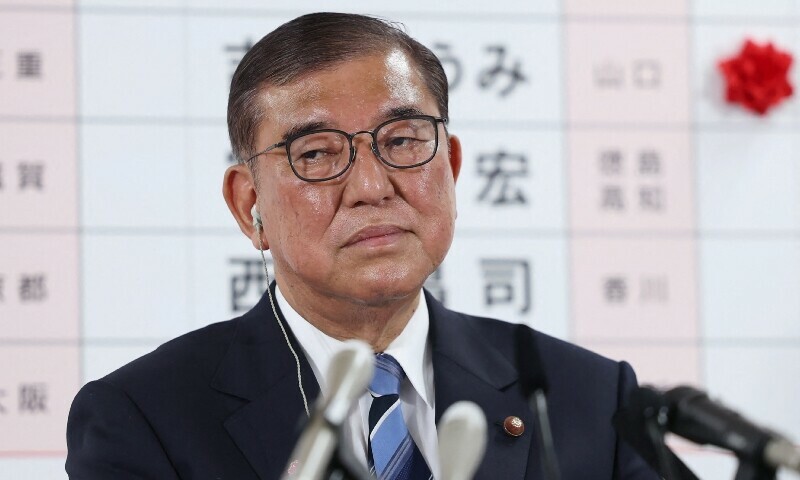

TOKYO: Japan’s Prime Minister Shigeru Ishiba expressed his intention to stay in the position on Sunday, after his ruling Liberal Democratic Party is projected to lose the upper house majority at Sunday’s election.
The polls on Sunday proved to be a debacle for Ishiba and could end his short premiership, local media projected.
However, Ishiba, when asked by a reporter if he intends to stay as prime minister and the ruling party leader, said “that’s right”.
“We are engaged in extremely critical tariff negotiations with the United States…we must never ruin these negotiations,” he said during a joint press interview at the party’s headquarters in Tokyo as vote count continued.
Ishiba’s coalition loses majority in upper house of parliament
Earlier, Ishiba told broadcaster NHK that poll results so far were “a difficult situation, and we have to take it very humbly and seriously”.
Asked about his future, he said, “We can’t do anything until we see the final results, but we want to be very aware of our responsibility,” Ishiba added.
Poll results so far showed Prime Minister Ishiba’s coalition has lost its majority in the House of Councillors — the upper house of parliament.
Ishiba’s Liberal Democratic Party (LDP) and its partner Komeito won around 41 of the 125 upper house seats contested on Sunday, short of the 50 needed to retain a majority, Nippon TV and TBS projected, based on exit polls.
National broadcaster NHK projected that the LDP could win between 27 and 41 seats and Komeito between five and 12, making it “difficult” to retain a majority.
The right-wing populist party Sanseito was meanwhile projected to have made strong gains, winning between 10 and 22 seats, adding to the two it already holds in the 248-seat upper house.
Hidehiro Yamamoto, a politics and sociology professor at the University of Tsukuba, told AFP that Ishiba may be “replaced by someone else, but it’s not clear who will be the successor”.
Ishiba’s centre-right LDP has governed Japan almost continuously since 1955, albeit with frequent changes of leader.
He took over in September on his fifth attempt and immediately called elections.
But this backfired and the vote left the LDP and its small coalition partner Komeito needing support from opposition parties, stymying its legislative agenda.
‘Japanese first’
The last time the LDP lost power was in 2009, when the now-defunct Democratic Party of Japan governed for a rocky three years.
Today, the opposition is fragmented, and chances are slim that the parties can form an alternative government.
The “Japanese-first” Sanseito wants “stricter rules and limits” on immigration, opposes “globalism” and “radical” gender policies, and wants a rethink on decarbonisation and vaccines.
Published in Dawn, July 21st, 2025