Bank ordered to end free Labubu doll promotion
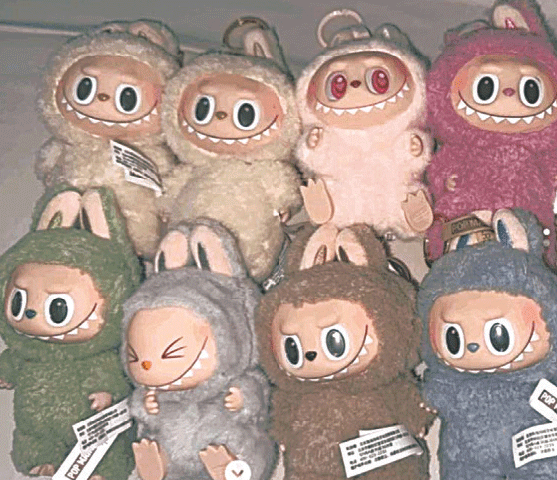
Ping An Bank, in Shenzhen, China, has been ordered to end a promotion offering free Labubu dolls to new customers who deposit at least $7,000 for three months.
The National Financial Regulatory Administration’s Zhejiang branch barred the giveaway, citing concerns that such non-banking perks could increase banking costs.
Labubu dolls, created by artist Kasing Lung and sold by Pop Mart, have become sought-after collectibles, boosted by celebrity endorsements from stars like Lisa of Blackpink and Rihanna.
Hyundai’s flat robots could revolutionise parking
Hyundai has developed sleek parking robots that can slide under most cars, lift them and park them automatically — no engine or driver needed. The WIA system, made of flat metal slabs just 110 mm tall, uses cameras and LiDAR to locate and move vehicles weighing up to 2.2 tonnes at 1.2 metres per second.
Unveiled last year, the robots work in sync, guided by QR codes and a smart control system that can manage up to 50 units at once. It is already in use at Hyundai’s Seongsu office in Seoul and its Singapore Innovation Centre.
A similar concept was developed by China’s Shenzhen Shanyi Technologies to remove illegally parked cars more efficiently than traditional tow trucks.
The world’s largest game of red light, green light
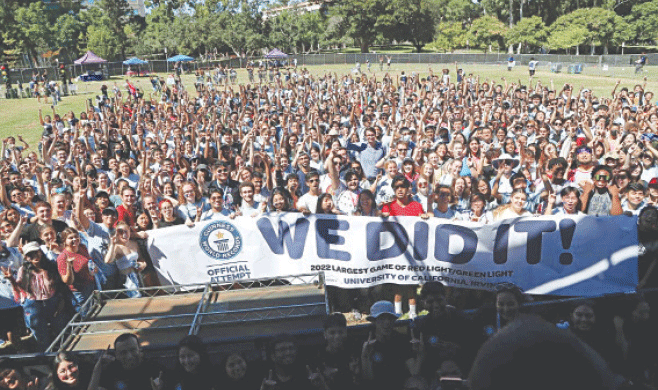
A fitness group in California, CF Fitness Inc., set a Guinness World Record by organising the largest game of “Red Light, Green Light” with 1,423 participants.
The event at Yorba Park in Anaheim included students from the Anaheim Elementary School District, their families, students from other districts, local firefighters, police officers and city officials.
The participants were particularly enthusiastic, with even an older police officer joined in, highlighting the importance of play for all ages.
432 robots relocate a historic neighbourhood
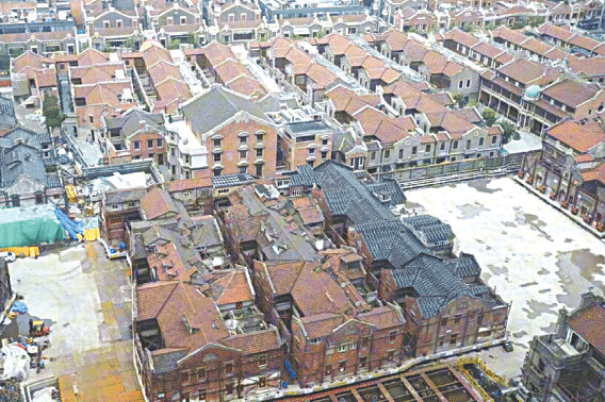
Shanghai recently relocated a 1920s-era shikumen-style building complex, using 432 hydraulic-powered robots, moving it 10 metres per day. The Huayanli complex in the Zhangyuan area was shifted to make way for a three-story underground structure, in what is now China’s largest and most complex relocation project of its kind.
Due to the site’s tight layout, engineers used 3D modelling, AI, and scanning technologies to plan the move. The 7,382-tonne complex was lifted onto a steel frame and moved using remote-controlled, self-walking robots capable of navigating narrow spaces.
The neighbourhood began its “walk” on May 19 and will return to its original spot once the underground construction — set to include cultural spaces, over 100 parking spots and subway connections — is complete.
Published in Dawn, Young World, July 5th, 2025