0
0

By now, most people have likely seen Aamir Khan’s latest film, Sitaare Zameen Par and experienced a familiar, sinking feeling upon discovering its inspiration: the 2023 Spanish film Campeons.
Directed by R.S. Prasanna, this Bollywood adaptation is not a plagiarised copy — it is an official remake (in today’s digital age, blatant copying is no longer a viable form of creative “copying”).
This isn’t Aamir Khan’s first brush with Western influences. Since his debut as a romantic hero in Qayamat Se Qayamat Tak (1988), Aamir has starred in more than a dozen films heavily inspired by international originals.
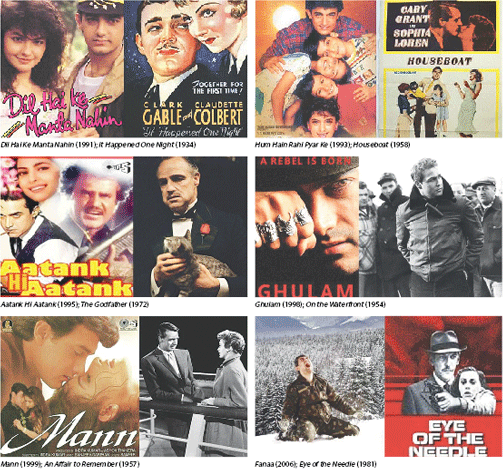
Whether it’s a 1930s classic or a contemporary hit, Aamir has shown a consistent knack for recycling global cinema through his own creative lens. Take Dil Hai Ke Manta Nahin (1991), for instance, where Aamir played a role first immortalised by Clark Gable in Frank Capra’s 1934 classic It Happened One Night.
In place of Claudette Colbert, the Hindi version featured director Mahesh Bhatt’s daughter, Pooja Bhatt. With its chart-topping music by Nadeem-Shravan, the film is still remembered for songs such as ‘Tu pyaar hai kissi aur ka’ and the title track. Ironically, just three months after the film’s release, Frank Capra passed away — some joked that perhaps he saw the remake and his heart couldn’t take it.
In 1992, Aamir starred in Daulat Ki Jung, a lesser-known film that was essentially a reimagining of Mackenna’s Gold, the Hollywood epic starring Gregory Peck and Omar Sharif. It was more than a homage — it was an open declaration of cinematic war against J. Lee Thompson’s original.
Aamir Khan has an enduring talent for reinterpreting global and regional cinema through the Bollywood lens, sometimes officially, often creatively and occasionally controversially
That same year, Jo Jeeta Wohi Sikandar was released, produced by Aamir’s uncle Nasir Hussain and directed by cousin Mansoor Khan. With an excellent soundtrack by Jatin-Lalit, the film bore strong similarities to the 1979 American film Breaking Away — complete with a bicycle race, college rivalry and the relentless pursuit of victory.
In 1993, Aamir’s father Tahir Hussain produced Hum Hain Rahi Pyar Ke, another Mahesh Bhatt-directed venture that closely mirrored Houseboat (1958), starring Cary Grant and Sophia Loren. While Grant had three children in the original, Aamir’s character was the uncle of three mischievous kids. Juhi Chawla played the romantic lead in the Bollywood version.
Two years later, in 1995, Aamir appeared in Aatank Hi Aatank as Munna — a film that shamelessly borrowed from The Godfather. Marlon Brando’s iconic role as Don Corleone was reimagined as Shiv Charan Sharma, a farmer-turned-gangster played by Ishrat Ali. The film also featured Rajinikanth and, once again, Juhi Chawla.
Obsession with The Godfather was evident when the movie’s legendary theme found its way, the same year, into the soundtrack of ‘Akele hum akele tum’, composed by Anu Malik. Try listening to ‘Raja ko Rani se pyaar ho gaya’ without hearing the shadow of Nino Rota’s original.
Akele Hum Akele Tum (1995) itself was based on Kramer vs Kramer (1979), with Aamir stepping into Dustin Hoffman’s shoes and Manisha Koirala echoing Meryl Streep’s role. In 1999, the same duo starred in Mann, a Hindi spin on An Affair to Remember (1957), the Cary Grant-Deborah Kerr romance.
Even Marlon Brando’s legacy wasn’t left untouched. Aamir’s 1998 film Ghulam, directed by Vikram Bhatt, mirrored the moral arc and gritty tone of On the Waterfront (1954). The film’s soundtrack, particularly Aamir’s rendition of the now iconic ‘Aati kya Khandala’, gave it a distinct flavor — one of the few elements not borrowed.
Then came Fanaa in 2006. Post-interval, the film took a sharp turn, borrowing cues from Donald Sutherland’s 1981 thriller Eye of the Needle, in which Sutherland played a terrorist — a role Aamir portrayed convincingly in the Indian version.
A.R. Murugadoss’s Ghajini (2008) was a commercial adaptation of Christopher Nolan’s Memento (2000). While Nolan’s film was cerebral and non-linear, Ghajini transformed it into an emotionally charged, action-heavy revenge saga.
Perhaps the most ambitious of Aamir’s borrowings was Laal Singh Chaddha (2022), the official Indian remake of Forrest Gump (1994). Aamir acquired the rights, had actor Atul Kulkarni adapt the screenplay, and produced the film himself. Though it was well-intentioned and competently made, the film flopped so spectacularly that one critic joked it left Aamir “stripped down to his chaddi [underwear]” as a producer.
When it comes to Pakistan, Aamir Khan hasn’t shied away from drawing inspiration from Lollywood either. Whether it was the space-entry concept from Saeed Rizvi’s Shaani (1989) or the trials of Rangeela’s donkey-turned-human character Mangoo in Insaan Aur Gadha (1973), elements from these films have echoed in his work.
And who can forget Hasan Askari’s Beqarar (1986), starring Faisal Rehman as “Sunny” and Babra Sharif as “Aini”? With a conventional romantic plot, soulful music by M. Ashraf and strong performances, the story follows a bespectacled photographer obsessively in love with a model. In 1990, Bollywood released Deewana Mujh Sa Nahin, starring Aamir Khan as Ajay and Madhuri Dixit as Anita.
Critics and audiences noted its striking resemblance to Beqarar — right down to character quirks, storyline and visual motifs. Despite being a near scene-by-scene remake, the film failed to recreate the original’s charm and emotional depth.
All these films reflect Aamir Khan’s enduring talent for reinterpreting global and regional cinema through a Bollywood lens — sometimes officially, often creatively and occasionally controversially.
As for Sitaare Zameen Par, let’s see which way it goes — either soaring to the stars or crashing down to Earth.
Published in Dawn, ICON, June 29th, 2025