Karachi residents feel more low-intensity tremors

Published June 2, 2025
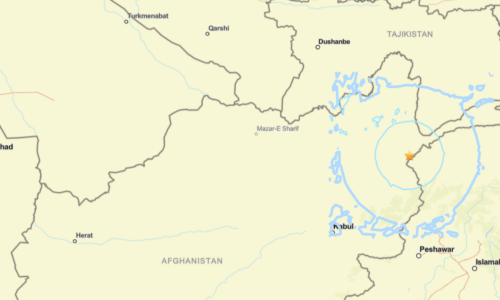
This illustration shows the two areas where tremors were felt by Karachi residents on June 1 and June 2. — via Google Map

Another low-intensity earthquake was felt by Karachi residents on Monday, according to the Pakistan Meteorological Department (PMD).

The tremor was the third within 24 hours.

The most recent quake measured 3.2 on the Richter scale with the city’s densely populated Quaidabad area as its epicentre. The area’s residents had also experienced a similar 3.6-magnitude tremor at 5:33pm yesterday.

Both earthquakes originated at a shallow depth of 10 kilometres beneath the surface.

A separate tremor originating near the city’s Gadap Town was recorded at 1:05am earlier today. It measured 3.2 on the Richter scale and had a depth of 12km.

Ameer Hyder, the chief meteorologist at the Met Office in Karachi, told Dawn.com that the tremors were caused by an active fault line in Landhi.

He noted that the quakes’ intensity was not high and was “gradually declining”. While stating that no formal prediction could be made yet, Hyder expected the tremors to end within a week.

 This screengrab shows a “normal” active earthquake fault line near the Korangi area of Karachi. — via ArcGIS based on information by the Global Earthquake Model Foundation
This screengrab shows a “normal” active earthquake fault line near the Korangi area of Karachi. — via ArcGIS based on information by the Global Earthquake Model Foundation

Experts have previously pointed out that such minor seismic activities “preempt” high-intensity earthquakes by constantly releasing accumulated energy within the tectonic plates.

The country had witnessed around 20 low-intensity earthquakes in the first half of February — an average of more than one tremor each day.

In April, jolts were felt in parts of Khyber Pakhtunkhwa and Punjab — including Peshawar, Islamabad, Rawalpindi and Lahore — twice that month.

Pakistan falls on three major tectonic plates — the Arabian, Euro-Asian and Indian — according to geological engineer Muhammad Rehan, creating five seismic zones within the country.


Additional input by Imtiaz Ali
Opinion

Editorial

Momentary relief
Updated 10 May, 2026

Momentary relief

THE IMF’s approval of the latest review of Pakistan’s ongoing Fund programme comes at a moment of growing global...
India’s global shame
10 May, 2026

India’s global shame

INDIA’s rabid streak is at an all-time high. Prejudice is now an organised movement to erase religious freedoms ...
Aurat March restrictions
Updated 10 May, 2026

Aurat March restrictions

The message could not have been clearer: women may gather, but only if they remain politically harmless.
Removing subsidies
Updated 09 May, 2026

Removing subsidies

The government no longer has the budgetary space to continue carrying hundreds of billions of rupees in untargeted subsidies while the power sector itself remains trapped in circular debt, inefficiencies, theft and under-recovery.
Scarred at home
09 May, 2026

Scarred at home

WHEN homes turn violent towards children, the psychosocial damage is lifelong. In Pakistan, parental violence is...
Zionist zealotry
09 May, 2026

Zionist zealotry

BOTH the Israeli military and far-right citizens of the Zionist state have been involved in appalling hate crimes...