Iran on Wednesday said it may consider allowing US inspectors with the United Nations nuclear watchdog to inspect its facilities if a deal is reached with the United States.
Iran has long been accused by Western powers of seeking to develop nuclear weapons — a claim Tehran has consistently denied, insisting its nuclear programme is solely for peaceful, civilian purposes.
Tehran and Washington have in recent weeks held five rounds of talks aimed at the issue — their highest-level contact since the US withdrew from the 2015 nuclear deal under Donald Trump in 2018.
“Countries that were hostile to us and behaved unprincipledly over the years — we have always tried not to accept inspectors from those countries,” Iran’s nuclear chief Mohammad Eslami told reporters, referring to staff from the International Atomic Energy Agency (IAEA).
Iran “will reconsider accepting American inspectors through the agency” if an agreement is reached and Tehran’s demands are taken into account, he added.
Since returning to office in January, Trump has reinstated his “maximum pressure” policy on Tehran, including the imposition of new sanctions on Iran.
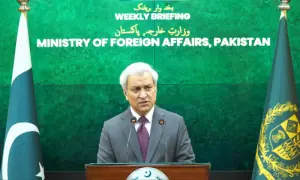
Foreign Ministry spokesman Esmaeil Baqaei said Wednesday that “consultations are ongoing regarding the time and location of the next round of talks, and once finalised, they will be announced by Oman.”
Iranian President Masoud Pezeshkian, currently on an official visit to Oman, thanked the Gulf state for its mediation efforts between the longtime adversaries, which have had no formal diplomatic ties since 1979.
‘Non-negotiable’
While welcoming the negotiations, Iranian officials have repeatedly declared uranium enrichment a “non-negotiable”. US officials, including Washington’s representative in the talks, Steve Witkoff, have also publicly identified it as a red line.
Eslami also said that the issue of enrichment “has not been raised at all” and “the enrichment percentage should not be raised politically”.
“The enrichment percentage depends on the type of use. When highly enriched uranium is produced, it does not necessarily mean military use,” he told reporters.
Baqaei said: “The continuation of enrichment in Iran is an inseparable part of the country’s nuclear industry and a fundamental principle for the Islamic Republic of Iran,” he added.
“Any proposal or initiative that contradicts this principle or undermines this right is unacceptable.”
Iran currently enriches uranium up to 60 per cent — the highest level of any non-nuclear weapons state — still below the 90pc threshold required for a nuclear weapon, but far above the 3.67pc limit set under the 2015 deal.
The European parties to the 2015 nuclear accord — France, Germany, and the United Kingdom — are weighing whether to trigger the agreement’s “snapback” mechanism, which would reinstate UN sanctions on Iran for non-compliance.
Tehran has repeatedly warned against activating the measure.