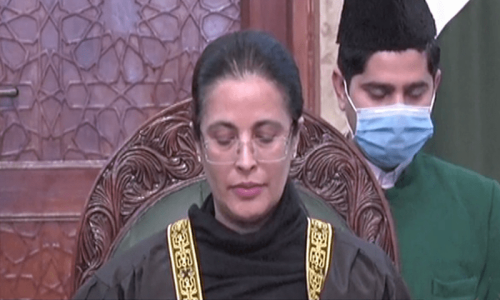
ISLAMABAD: Chief Justice of Pakistan (CJP) Yahya Afridi has said the technology is a powerful tool to build institutional trust, eliminate barriers to access, and enhance the quality of justice, calling upon all stakeholders to move forward with unity and resolve to shape a judicial system that meets the needs of the present and earns the confidence of future generations.
In his keynote address at the symposium titled ‘Use of Technology in Judicial System in Pakistan: Prospects and Promises’, being organised by Law and Justice Commission of Pakistan (LJCP), the chief justice highlighted that the integration of technology into the justice system was not simply a matter of modernisation — it is essential to making courts more accessible, transparent, and efficient for the people they serve.
He described the symposium that brought together esteemed members of the judiciary, international experts, and senior government officials to explore the future of judicial reforms through digital transformation, as timely and forward-looking, aligning with the reform agenda to be deliberated by the National Judicial (Policy Making) Committee in its forthcoming meeting.
The CJP acknowledged the vital contributions by jstices Muhammad Ali Mazhar, Shahid Waheed, Ali Baqar Najafi for leading this initiative. He also extended a warm welcome to international guests.
Reflecting on the reforms underway, Mr Afridi highlighted the key digital innovations recently implemented by the Supreme Court.
He stressed that resistance to technological change must not impede progress, and emphasised the need for a comprehensive national framework to guide judicial digital transformation including robust cybersecurity protocols, ethical guidelines for AI use, and a culture of collaboration involving high courts, judicial academies, government institutions, academia, and the legal community.
On the occasion, Justice Waheed presented an overview of the progress and evolution of information technology within Pakistan’s judicial system.
Federal Secretary for Information Technology and Telecom Zarrar Hasham Khan, in his speech, outlined Pakistan’s digital infrastructure plans.
The symposium was addressed by international experts, including Li Xiaohui, an expert from the Supreme People’s Court of China, who shared China’s digital journey in judicial reforms.
Prof Dr Hasan Mandal, the rector of Istanbul Technical University, Turkiye presented a global view on how courts were adopting technology, while Prof Dr Cetin Elmas of Gazi University, Turkiye, discussed the growing role of Artificial Intelligence in shaping the future of justice delivery. Published in Dawn, May 27th, 2025