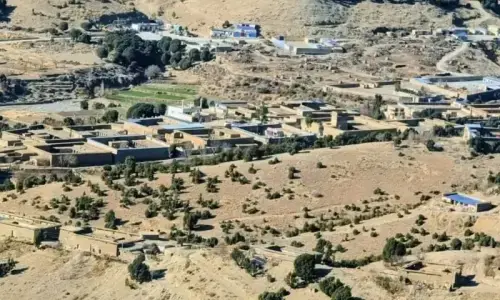
Wapda takes stock of damage to Neelum-Jhelum dam



MUZAFFARABAD: Water and Power Development Authority (Wapda) Chairman retired Lt Gen Sajjad Ghani on Thursday visited the Neelum-Jhelum Hydropower Project (NJHP) dam site to assess damage from Indian shelling and to boost the morale of the staff deployed on-site.
The chairman was informed during a detailed inspection of the weir, de-sanders, and intake that the shelling began at 1:15am on May 7 and continued for approximately six hours, ending at 7:15am.
The bombardment damaged a hydraulic power unit of an intake gate and reinforced concrete structures at de-sanders 1 and 3. A residential camp and a medical facility, including an ambulance, were also targeted, according to officials.
Mr Ghani “strongly condemned the Indian attack on the power project,” saying international law, including an additional protocol to the Geneva Conventions of Aug 12, 1949, prohibited attacks on water infrastructure, even during full-scale wars between states.
Attack condemned as ‘act of war’; damage to systems could have triggered ‘massive flooding’
“The coward enemy’s attack is unacceptable and it will be taken up with the respective forums,” he told media at the project site. “It is an act of war which is not acceptable for Pakistan. Even in World War I, World War II and other wars, no one targeted water reservoirs, projects, etc., under norms.”
He said damage to the project’s automated systems could have caused “massive flooding from Muzaffarabad to Mangla”.
“Thank God, our project’s automated system remained safe,” he said. “And had these been affected, there would have been a flood situation from Muzaffarabad to Mangla. Our country escaped a big disaster.”
The Wapda chairman praised the project staff for their “dedication and courage” in taking timely action to protect vital installations. He was accompanied by Muhammad Arfan Miana, acting member for power and chief executive officer of the NJHP Company, as well as the chief engineer and project director, and the chief engineer for operations and maintenance of the project.
A day earlier, ISPR Director General Lt Gen Ahmed Sharif Chaudhry also condemned the attack, describing it as a “flagrant violation of international law and conventions”. He said targeting Pakistan’s water infrastructure “represented a dangerous escalation and posed serious humanitarian and environmental risks.”
The 969MW project completely halted power production at 6am on May 1, 2024, after its remaining two turbines were shut down due to deteriorating conditions in its Headrace Tunnel. The first two turbines had been shut down in early April 2024 following a reduction in tunnel pressure, just days after the project had briefly achieved full generation capacity.
Khalid Hasnain in Lahore also contributed to this report
Published in Dawn, May 9th, 2025