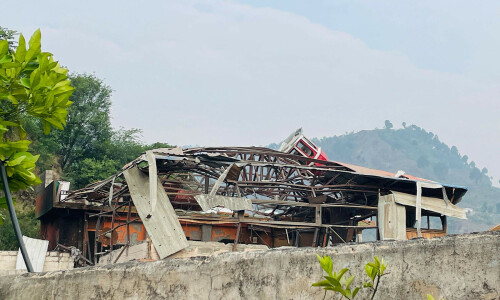
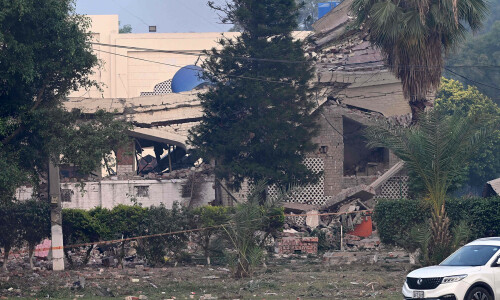
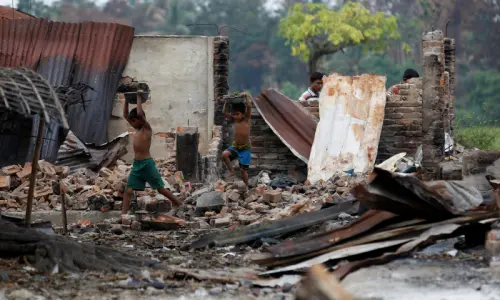
India said it attacked Pakistan early on Wednesday following a deadly attack on tourists in Kashmir last month. Pakistan reported eight deaths and said it had responded to the Indian strikes.
This is what global leaders have said about the latest hostilities between the nuclear-armed neighbours:
Turkish foreign ministry
Turkiye warned of the “risk of all-out war” between India and Pakistan, in a statement from the Foreign Ministry.
“Last night’s attack by India poses the risk of all-out war. We condemn this provocative move and attacks targeting civilians and civilian infrastructure,” the ministry wrote.
German foreign ministry
The German government called to prevent “any escalation” and urged to “protect civilians.”
Berlin, in contact with both countries, has opened a crisis unit to “monitor the situation closely,” the Foreign Ministry said on X. This is the most serious military confrontation between India and Pakistan in two decades.
Qatar foreign ministry
The state of Qatar, in a statement posted on X, expressed concern over the continuing escalation, urging both countries “to exercise maximum restraint, give priority to the voice of wisdom, respect the principles of good neighbourliness and resolve the crisis through diplomatic means. “
Chinese foreign ministry
“India and Pakistan are neighbours that cannot be moved apart, and they are also China’s neighbours,” a foreign ministry spokesperson said in a statement.
“We call on both India and Pakistan to prioritise peace and stability, remain calm and restrained and avoid taking actions that further complicate the situation,” the spokesperson added.
Beijing also offered to play a mediating role in reducing tensions.
“We are willing to work together with the international community and continue to play a constructive role in easing the current tensions,” foreign ministry spokesman Lin Jian said.
UK Trade Secretary Jonathon Reynolds
The UK is ready to support both India and Pakistan to de-escalate tensions, Trade Secretary Jonathan Reynolds said.
“Our message would be that we are a friend, [and] a partner to both countries. We stand ready to support both countries. Both have a huge interest in regional stability, in dialogue, in de-escalation and anything we can do to support that, we are here and willing to do,” he told BBC radio.
Russian foreign ministry
Russia’s foreign ministry in a statement said it was “deeply concerned by the escalation of military confrontation,” and called on the parties to “exercise restraint to prevent further deterioration.”
The foreign ministry hoped the tensions could be “resolved through peaceful, diplomatic means.”
Japan Chief Cabinet Secretary Yoshimasa Hayashi
“In regard to the terrorist act that occurred in Kashmir on April 22, our country firmly condemns such acts of terrorism. Furthermore, we express strong concern that this situation may lead to further retaliatory exchanges and escalate into a full-scale military conflict. For the peace and stability of South Asia, we strongly urge both India and Pakistan to exercise restraint and stabilise the situation through dialogue.”
French Foreign Minister Jean-Noel Barrot
France also called on India and Pakistan to show restraint.
“We understand India’s desire to protect itself against the scourge of terrorism, but we obviously call on both India and Pakistan to exercise restraint to avoid escalation and, of course, to protect civilians,” Foreign Minister Jean-Noel Barrot, said in an interview on TF1 television.
“I don’t think anyone has an interest in a lasting confrontation between India and Pakistan,” he said, adding that he would be speaking with his counterparts in India and Pakistan.
Earlier today, US President Donald Trump expressed disappointment over the incident, calling it a “shame”, while US Secretary of State Marco Rubio hoped for engagement towards a peaceful resolution. UN Secretary General Antonio Guterres urged both countries to exercise “maximum military restraint”.