Yemeni prime minister announces resignation
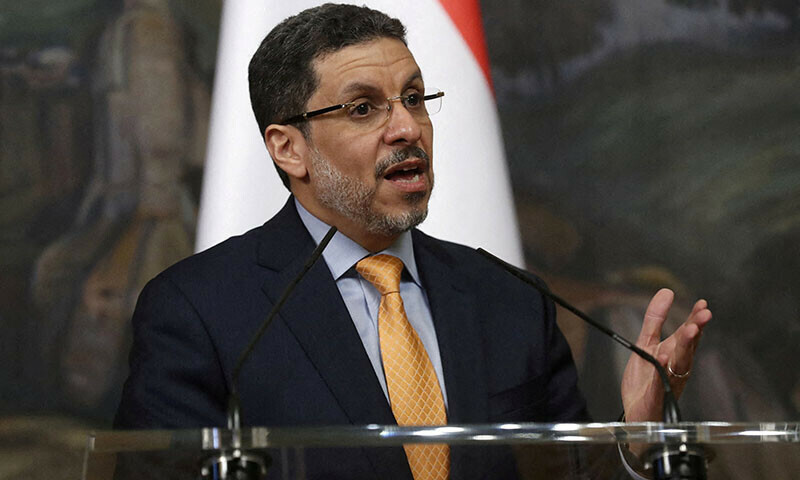
The premier of Yemen’s internationally recognised government, former diplomat and foreign minister Ahmed Bin Mubarak, announced his resignation on Saturday, saying he was unable to fully exercise his powers.
Yemen’s government withdrew to Aden in the south after Houthi rebels seized the capital Sanaa in 2014 and then went on to control most population centres in the impoverished Arabian Peninsula country.
A Saudi-led military coalition intervened in support of beleaguered government forces in 2015, but with little success.
“I have just met with His Excellency the Chairman of the Presidential Leadership Council, Dr Rashad Al-Alimi, and resigned as Prime Minister,” Bin Mubarak posted on X, also sharing his resignation letter.
“I could not exercise my constitutional powers and take the necessary decisions to reform government institutions or implement rightful governmental changes,” the letter said.
His move comes as the Houthis wage a campaign of missile attacks on Israel and target shipping in key waterways in what they say is a show of solidarity with Palestinians over the conflict in Gaza.
Bin Mubarak said that despite obstacles, he had managed to achieve “many successes in a short space of time”, citing fiscal and administrative reforms and an anti-corruption drive.
However, analyst Mohammed Albasha, of the US-based Basha Report Risk Advisory, told AFP that Bin Mubarak had been “in constant friction with the Presidential Leadership Council”.
Albasha said the main driver behind the resignation was that “Bin Mubarak wanted to be more than prime minister — he wanted the powers of the presidency. That aspiration isolated him politically.
“His drive for greater power — viewed by many as fuelled by personal ambition — led to repeated confrontations with key ministers and most Council members.”
“Over time, this power struggle eroded trust,” he added.
‘Deep divisions’
Bin Mubarak, Yemen’s former ambassador to the United States, is a staunch adversary of the Houthis, who abducted him in 2015 and held him captive for several days.
He previously served as chief of staff of the presidential office and was also appointed Yemen’s envoy to the United Nations in 2018. He was appointed foreign minister in 2018 and prime minister on February 5, 2024.
Bin Mubarak called on the European Union to designate the Houthis a terrorist group, and advocated increased military support for government forces as the Houthis launched Red Sea attacks.
His departure should “ease internal tensions and reduce the deep divisions that have plagued Yemen’s internationally recognised government — a necessary and positive step toward restoring cohesion”, Albasha said.
The conflict in Yemen has caused hundreds of thousands of deaths and triggered one of the world’s worst humanitarian crises, although the fighting has decreased significantly since the United Nations negotiated a six-month truce in April 2022.
Since fighting in the Gaza Strip broke out in October 2023 after Hamas attacked Israel, the Houthis have repeatedly targeted Israel and ships in the Red Sea and Gulf of Aden that they say are linked to it.
The Houthis paused their attacks during a recent two-month Gaza ceasefire, but in March, their threat to resume attacks over Israel’s aid blockade of Gaza triggered a renewed and sustained US air campaign targeting areas in Yemen under rebel control.