0
0

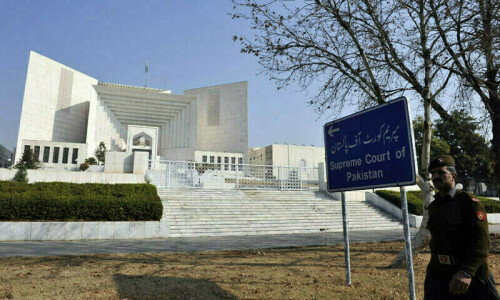
ISLAMABAD: The Supreme Court has ruled that the chief justices of high courts are responsible for supervising and regulating the proceedings of lower courts, including the Anti-Terrorism Courts (ATC).
The order was issued by a three-judge bench on an appeal filed by the Punjab government against the Lahore High Court (LHC) chief justice’s refusal to transfer cases from one ATC judge to another.
In June 2024, the then LHC chief justice Malik Shahzad Ahmad Khan dismissed the Punjab government’s appeal to transfer May 9 cases involving PTI founder Imran Khan and other leaders from Rawalpindi ATC Judge Malik Ejaz Asif.
Justice Khan, who is now a Supreme Court judge, had also imposed a fine of Rs200,000 on the government.
Judge Asif had drawn the ire of the Punjab government for visiting the incarcerated PTI leader in prison. The provincial government also filed a reference against the judge, accusing him of being “sympathetic” to Mr Khan.
The reference was also dismissed by the then LHC chief justice.
The SC bench, headed by Chief Justice of Pakistan (CJP) Yahya Afridi, noted the Punjab government had taken a particular exception to some paragraphs of Justice Khan’s order.
It argued that the paragraphs were not only “uncalled for” but also beyond the LHC chief justice’s mandate.
The paragraphs in question were about the professional conduct of the judicial officers and “disapproving the conduct” of the Punjab government, the Supreme Court noted, without reproducing the observations in its order.
In the judgment, CJP Afridi said it was essential to recognise the special supervisory authority vested in LHC CJ under Article 203 of the Constitution — which empowers high courts to “supervise and control” all subordinate courts.
In light of this provision, the SC order noted, the LHC chief justice was “not only empowered to address the issue at hand with his discretion, but also duty-bound to protect the Presiding Judges of the District Judiciary from any undue executive influence”.
The judgment said the LHC chief justice “duly considered” the reference brought by the Punjab government against the ATC judge accusing him of bias.
However, after taking into consideration the allegations and the response of the ATC judge, the LHC CJ decided to file the reference but ultimately dismissed it over insufficient grounds, the SC order stated.
After the reference was dismissed, the government filed the transfer application “solely on the fact that a reference had been made, despite no convincing evidence being presented to substantiate the allegations”.
“This sequence reinforces the conclusion that the transfer request lacked sufficient merit to justify further action.”
The SC judgment also noted that the LHC CJ acted within his constitutional authority under Article 203 to supervise the proceedings of subordinate courts.
After dismissing the reference against the ATC judge, the LHC CJ was also “fully justified” in not taking further action on the transfer application.
The Supreme Court noted the administrative actions of the LHC CJ to manage and supervise lower courts should not be disturbed unless they are “blatantly unreasonable, capricious or arbitrary”.
“[This is] not apparent in the circumstances of the present cases,” the judgment said.
The court noted that observations made by the LHC CJ, whether favourable or adverse, will not be binding in any future proceedings.
“The praise directed towards judicial officers should not be construed as a shield that protects them from legitimate scrutiny, nor should the critical remarks regarding state functionaries … treated as a sword to prejudice or undermine their future conduct.”
Published in Dawn, April 12th, 2025