DURING the last week of Ramazan, malls and shopping centres across Pakistan begin to mirror a kind of quiet chaos — a ritualistic frenzy that has now over the years become inseparable from the season. Eid shopping, once rooted in warmth, tradition and small pleasures, now borders on the edge of consumerist overkill.
A visit to a mall in Lahore before the Eid this year brought this realisation into sharp focus. While parking was sur-
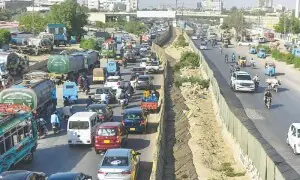
prisingly manageable, the road leading to the entrance — the main phase VI stretch — was a bottleneck of honking traffic and clogged intersections. It set the tone for what laid ahead.
Inside the mall, the scene was over-whelming. Within the spacious stores, clothing racks, though abundant, were packed so closely that browsing felt more like a battle than a leisure activity.
Each outfit was pressed against another, forcing the customers to pry, pull and dig through layers of fabric just to get a glimpse of a design. The only pieces that commanded attention were either on mannequins or positioned strategically at the front of the store.
One could not help but pause at the price tags. A simple, digitally printed lawn suit was priced at Rs13,000. Add a dupatta, and the cost shot up to Rs18,000. Embroidered suits hovered around Rs20,000, and three-piece printed and embroidered suits carried price tags starting at Rs18,000. And this was not haute couture; these were mass-produced collections.
These brands maintain uniform pricing across the country. So while the mall in Lahore may cater to a more affluent demographic, the price of the same outfit in other cities, and less affluent localities, remains the same.
In the spirit of Eid, a nearly 40 per cent mark-up has become the norm, only to be slashed in post-Eid ‘summer sales’, where the very same items are presented at a lightly more reasonable prices. As such, despite inflation and severly reduced purchasing power, Eid remains the single most lucrative season for retailers. According to reports, the average price of ready-to-wear Eid outfits jumped nearly 25pc to 40pc compared to 2022, while customer footfall, especially in urban centres, remained largely un-affected during peak hours post-iftar.
This is perhaps the paradox of the Eid economy — the visible strain and the simultaneous splurge. A large segment of Pakistan’s population earns the minimum monthly wage of around Rs35,000. Spending Rs15,000 on a single outfit raises uncomfortable questions about afford-ability, social pressure, and the commer-cialisation of what was once a modest celebration.
As I tried to manoeuver my way around the store, I found myself losing the essence of the shopping experience itself. Eid shopping, for many of us, was once a tactile joy — being able to touch fabrics, lay a few options out, try them on, and walk away with something that made us feel festive and comfortable. That intimacy has now been swallowed up by queues, cramped spaces, and decision fatigue.
The deeper question is cultural. Where did this tradition of extravagantly priced clothing enter the spirit of Eid? Growing up, Eid meant food, laughter, bangles, henna and, above all, family. New clothes were a part of the celebration, but not the main character. Today, they seem to dominate the narrative.
Even so, despite the price hikes and the overcrowding, people continue to spend. Chand Raat brings traffic to a halt. Markets stay open till dawn. The glitter of new suits still draws people into long lines.
That is the strange resilience of Eid in Pakistan. It is at once joyful and over- whelming, festive and tiring. It appears that somewhere in this whole mess, we continue to seek the comfort of tradition, even if it now comes at a steep price.
Mashal Rizvi
Lahore
Published in Dawn, April 9th, 2025