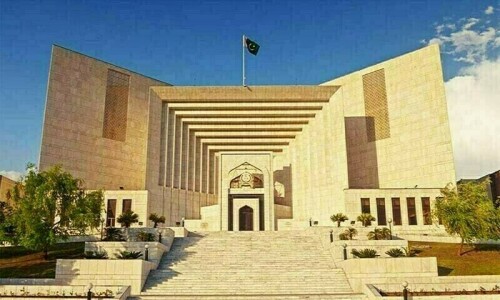
The Supreme Court’s Constitutional Bench on Monday fixed various pleas about the seniority issue in the Islamabad High Court (IHC), following the transfer of new judges from other provinces, for hearing on April 14.
A five-member bench headed by Justice Muhammad Ali Mazhar and comprising Justices Naeem Akhtar Afghan, Shahid Bilal, Salahuddin Panhwar and Shakeel Ahmed will hear the case.
The development is the latest in a row affecting the IHC after the transfers of new judges to the high court that led to a shakeup of the seniority list. The matter arose after the Ministry of Law and Justice issued a notification on February 1, transferring three sitting judges — Justice Sardar Mohammad Sarfraz Dogar, Justice Khadim Hussain Soomro and Justice Muhammad Asif — from their respective high courts to the IHC.
Justice Dogar was transferred from the Lahore High Court (LHC), Justice Soomro from the Sindh High Court (SHC) and Justice Asif from the Balochistan High Court (BHC). The controversy centred around the alteration of the seniority list following these transfers.
Five IHC judges — Justice Mohsin Akhtar Kayani, Justice Tariq Mehmood Jahangiri, Justice Babar Sattar, Justice Sardar Ejaz Ishaq Khan and Justice Saman Rafat Imtiaz — had filed a representation, contending that under the Constitution, a high court judge must take a new oath upon transfer to a different high court, which should affect their seniority ranking.
The five judges also did not attend Justice Dogar’s oath-taking ceremony as the acting IHC chief justice. They subsequently became litigants, petitioning the Supreme Court to resolve the controversy surrounding their seniority in the high court following the transfer of new judges from other provinces.
In the plea moved by senior counsel Muneer A. Malik, the petitioners asked the apex court to restrain judges transferred to the high court from performing judicial and administrative functions.
The petition, filed under Article 184(3) of the Constitution, also requested the Supreme Court to declare that Acting Chief Justice Sardar Muhammad Sarfraz Dogar, Justice Khadim Hussain Soomro, and Justice Muhammad Asif cannot be considered judges of IHC until they have taken a fresh oath in accordance with Article 194, read in conjunction with the Third Schedule of the Constitution. The petition will be placed before the Constitutional Bench for adjudication once it is taken up for hearing.
According to the petition, in line with the settled law established by the Supreme Court in the cases of Aslam Awan and Farrukh Irfan, the inter se seniority of the transferred judges should be determined from the date they took oath as justices of the IHC. Consequently, they will be placed lower in the seniority list than the petitioner judges.
The petition also requested the apex court to declare illegal the Feb 8 decision on similar representation by then-IHC chief justice Aamer Farooq and contrary to the settled law established by the Supreme Court. Consequently, the Supreme Court should set aside the decision on representation and the seniority list of Feb 3.
According to the plea, the Judicial Commission of Pakistan (JCP) wrongfully considered a defective seniority list of the IHC judges during its Feb 10 meeting, wherein the transferred judges were erroneously considered for elevation to the Supreme Court. It also asked to declare the Feb 12 notification by President Asif Ali Zardari appointing Justice Dogar as the acting CJ unlawful.
The petition also sought a direction that the IHC registrar should issue a revised seniority list under the declarations made by the Supreme Court. It said the reconstitution of the Administration Committee and the Departmental Promotion Committee was contrary to the law, established conventions, and judicial norms.
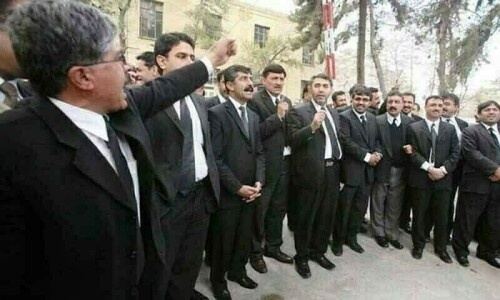
Similar petitions were also later filed by PTI’s jailed founder Imran Khan, the Lahore Bar Association and the Karachi Bar Association asking the Supreme Court to restrain the judges transferred to the IHC from performing their judicial and administrative functions.