ISLAMABAD: The number of people exposed to dangerously high levels of air pollution could be halved by 2040 with targeted policy action with economic benefits as high as $2.4 trillion, according to a new World Bank study.
The study, ‘Accelerating Access to Clean Air on a Livable Planet’ estimates that outdoor air pollution kills roughly 5.7 million people annually, with 95 per cent of deaths occurring in low- and middle-income countries.
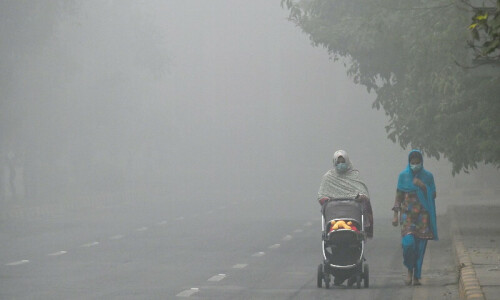
It adds that 99pc of the world’s population is exposed to unhealthy levels of air pollution that exceed WHO air quality guideline levels.
However, low- and middle-income countries face the highest burden.
WB calls for indigenous solutions to reform domestic, industrial sectors
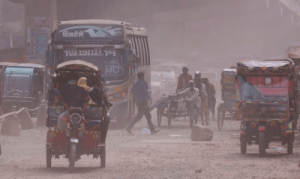
Eighty percent of people directly exposed to unsafe average annual PM2.5 concentrations live in low- and middle-income countries, where economic growth often relies on polluting technologies.
Most of them are in South Asia (1,200m) and East Asia (660m). A substantial portion of them live in Sub-Saharan Africa (330m) and Middle East and North Africa (224m).
Exposure to high levels of air pollution accounts for a loss equivalent to nearly 5pc of global GDP due to health impacts, lost productivity, and reduced life expectancy.
Ambient or outdoor air pollution accounted for more than 5.7m deaths globally in 2020 and remains a leading risk factor for premature death.
The corresponding economic damages are estimated at between $4.5tr and $6.1tr a year — equivalent to between 4.7pc and 6.5pc of global GDP, says the study released this week.
In South Asia, health damages from ambient air pollution exceeded the equivalent of 8.9pc of GDP in 2020, without accounting for the implications of lost productivity on future growth.
Poverty and inequality compound the health burden caused by being exposed to high levels of air pollution.
The agriculture sector, especially industrial farming, is a significant source of air pollution despite being negatively affected by it.
Intensive fertiliser use, poor manure management and the burning of crop residue, especially in Asia, contribute significantly to PM2.5 concentrations.
Over the next 15 years, the study says, existing and currently planned policies are expected to exacerbate uneven exposure to air pollution.
Policy changes
By 2040, existing or planned energy and climate policies and air quality measures are expected to curb global PM2.5 emissions by 6pc.
However, due to economic and population growth, the number of people exposed to PM2.5 levels is anticipated to increase by 15pc.
To cut emissions, the study calls for policy changes across sectors that cause air pollution — agriculture, urban development, transport, industry and residential cooking and heating.
As most outdoor air pollution is a result of human activities globally, these actions can help reduce particulate matter in the air that is harmful to health.
In some regions, desert dust contributes as a significant source of fine particulate matter.
The study emphasises that reducing air pollution in South Asia, Northeast Asia, the Middle East, and North Africa requires decisive action in power generation and industrial sectors.
Efforts to reduce industrial air pollution often generate economic returns and are associated with improvements in companies’ competitiveness.
However, market, financial, and technical support need to be tailored to countries’ specific industrial and socioeconomic landscapes.
Published in Dawn, March 30th, 2025