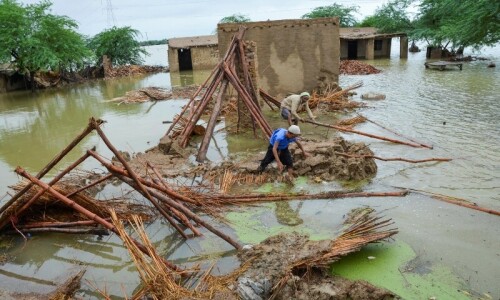
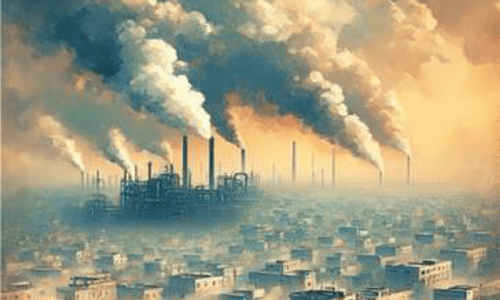
PAKISTAN teeters on the edge of an environmental abyss. Ranked among the most climate-vulnerable nations, it endures extreme heat, apocalyptic floods, prolonged droughts, and choking air pollution.
The annual smog that engulfs urban centres is not merely an inconvenience — it is a broader governance failure. Meanwhile, rural communities watch helplessly as their worlds disintegrate: glaciers retreat, monsoons become erratic, and fertile lands turn to dust.
Yet, climate change concerns continue to remain a footnote as politics dominates the national discourse, surfacing only when disaster strikes. A proactive approach, built on long-term resilience, is the obvious way forward. But what are we willing to do about it?
Dawn’s ‘Breathe Pakistan’ campaign is one attempt to make it central to the national conversation. However, Pakistan needs much more — it needs a revolution in environmental governance.
This demands unprecedented coordination among stakeholders: government bodies, industry leaders, international partners, researchers, CSOs, and communities. The time for symbolic gestures and non-binding commitments has passed.
The path forward requires fundamental shifts. First, climate change must be elevated to the highest tier of national security concerns, alongside terrorism and economic stability. This means overhauling environmental protection frameworks with substantial fines for polluters, stringent emissions controls, and massive investment in public transportation.
Urban planning must pivot from concrete-jungle expansion to green development, with strict preservation of remaining urban forests. Agriculture, both a casualty and a contributor to climate change, also requires urgent reform.
Pakistan’s excessive reliance on water-intensive crops has depleted underground reserves. The solution lies in introducing drought-resistant crop varieties, implementing water-smart irrigation systems, and incentivising farmers to adopt climate-resilient techniques. This revolution must be supported by a parallel energy transition, leveraging our abundant renewable resources — solar, wind, and hydroelectric power.
The private sector, often seen as part of the problem, must be brought into the solution. Corporate accountability on carbon footprints should be non-negotiable, with tax incentives for sustainable business practices.
Pakistan’s international partners, too, have a role — debt relief mechanisms tied to green development, knowledge transfers, and climate finance must be expanded to help chart a sustainable path.
Environmental education needs radical reimagining. Pakistan requires comprehensive climate literacy programmes integrated into school and university curricula. Media outlets must move beyond disaster coverage to sustained environmental journalism, investigating root causes and highlighting solutions. Change begins at the grassroots, and public participation is indispensable.
Pakistan’s survival hinges on its ability to treat climate change as the defining challenge of our time. Either we act now, or we surrender to a future of escalating disasters.
Published in Dawn, February 6th, 2025