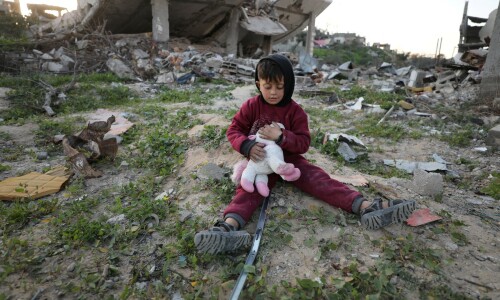
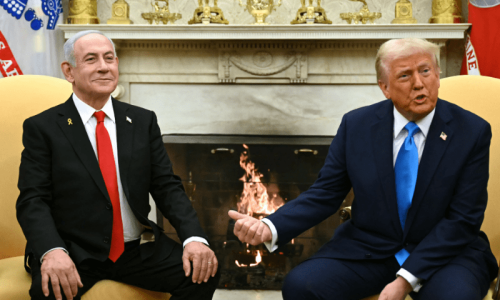
US President Donald Trump said he wants to resettle Palestinians from the Gaza Strip to Egypt and Jordan, demolish remaining buildings to make way for a Riviera-style development project and place the occupied territory under US “ownership”.
Forcing people to leave their land and taking over territory are prohibited by longstanding treaties. Following is a look at the ramifications of Trump’s plans under international law.
Taking control of territory
Trump said “the US will take over the Gaza Strip and we will do a job with it too…. I do see a long-term ownership position.”
The Gaza Strip is recognised by the United Nations and its highest court, the International Court of Justice, as part of the Palestinian territories under Israeli military occupation.
International law prohibits the seizure of territory by force, which is defined as an act of aggression. The UN Charter says: “All members shall refrain in their international relations from the threat or use of force against the territorial integrity or political independence of any state.”
“Ultimately, President Trump’s proposal amounts to a blatant rejection of the core tenets of international law that have operated since at least the end of World War II and the adoption of the UN Charter,” said Assistant Professor of International Human Rights Law Michael Becker at Trinity College, Dublin.
Were the United States to lay claim to the Gaza Strip, “this would amount to the unlawful annexation of territory. Nor does Israel have any right to cede Palestinian territory to the United States or to anyone else,” said Becker.
Janina Dill, co-director of the Oxford Institute for Ethics, Law and Armed Conflict and a specialist in international humanitarian law, said: “There are no circumstances in which it is permissible to seize territory by force. The argument that it benefits populations there or elsewhere is legally meaningless even if it were factually correct.”
Under the UN Charter, responsibility for identifying acts of aggression and responding to them falls to the Security Council, where the United States is a permanent, veto-wielding member.
Aggression is also one of the crimes that can be prosecuted before the International Criminal Court. The United States and Israel are not members of the ICC, but the court has asserted jurisdiction over the Palestinian territories, including over acts committed there by countries that are not members.
Moving Palestinians out
“Forcibly resettling the Palestinians of Gaza would constitute the crime against humanity of deportation or forcible transfer,” said Dill.
Trump has said Palestinian residents of Gaza would want to leave because it has become dangerous. But so far there has been no indication that the 2.3 million residents wish to go.
The Fourth Geneva Convention of 1949 prohibits the forcible transfer or deportation of protected persons in occupied territory.
According to the founding document of the International Criminal Court, the Rome Statute, “the term ‘forcibly’ is not restricted to physical force, but may include threat of force or coercion, such as that caused by fear of violence, duress, detention, psychological oppression or abuse of power against such person or persons or another person, or by taking advantage of a coercive environment.”
Dill said it was also likely that removing Palestinians from Gaza would require carrying out other large-scale crimes against them.
“The scale of such an undertaking, the level of coercion and force required mean this would very likely meet the threshold of a large scale and systematic attack against the civilian population.”
Preventing Gazans from returning
Trump has said that after Gaza residents leave, he does not envision them returning.
Preventing them from doing so would also amount to a violation of international legal principles under which displaced populations retain a right to return to lands they have fled.
Even a lawful evacuation by an occupying power “cannot involve sending people to a third country and it cannot be a pretext for ethnic cleansing or removing the population from the territory indefinitely or on a permanent basis,” said Becker.
UN Secretary-General Antonio Guterres told Al Arabiya TV that taking the population out of Gaza would “create a high risk that you make the Palestinian state impossible forever.”