ISRAEL’S Prime Minister Benjamin Netanyahu, who is wanted by the International Criminal Court (ICC) to face war crimes charges, will be feted next Tuesday at the White House by its latest occupant US President Donald Trump whose reiteration of his stance on the forced displacement of Gaza Palestinians to Egypt and Jordan has caused considerable anxiety to the two US allies.
President Trump told reporters on board Air Force One a week ago that “Gaza’s 1.5 million” (more like 2m minus the at least 50,000 who have perished in the 15 months of genocide by the Israeli Occupation Forces) population could be relocated to Egypt and Jordan ‘permanently’ or for a time because the destruction in Gaza has created a mess and needed a ‘clean out’, as he put it.
As Egypt and Jordan were responding to Trump’s outrageous suggestion, the White House issued Trump’s warmly worded invitation to Netanyahu, facing ICC arrest warrants for war crimes charges over his Gaza military campaign that many organisations and experts call a genocide: “Dear Prime Minister, I would like to formally invite you to the White House next week. I look forward to discussing how we can bring peace to Israel and its neighbours, and efforts to counter our shared adversaries. It will be my honour to host you as my first foreign leader in my second term.”
While Netanyahu would likely endorse the Trump plan and also be pushing for an all-out attack on Iran, Egypt and Jordan, two staunch US allies, voiced their serious opposition to the Trump plan and said the displacement of the Gazans was not a solution and would create more problems. Egypt’s President Abdel Fattah el-Sisi angrily suggested if Gazans have to be moved let it be to the (Israeli-occupied) Negev desert.
‘What was inescapable is that there is almost nothing left of Gaza.’
Late on Thursday, Trump was asked for his reaction to what his two Arab allies and Israel’s neighbours were saying and he retorted: “They’ll do it … we do a lot for them.” It was difficult to say whether his words were more of an expression of reality or his glum face.
Apart from Trump, White House envoy Steve Witkoff, told Axios.com in an interview at the end of his trip to the Middle East just before this weekend that rebuilding Gaza could take between 10 and 15 years: “What was inescapable is that there is almost nothing left of Gaza.”
“There is nothing left standing. Many unexploded ordnances. It is not safe to walk there. It is very dangerous. I wouldn’t have known this without going there and inspecting,” he said. It has also emerged now that Witkoff met Saudi Crown Prince Mohammed bin Salman in Saudi Arabia on his earlier visit to the region two weeks ago, when the ceasefire deal was announced.
While property tycoons/ developers Trump and Witkoff may have their own assessment of the potential value of the Gaza real estate to their main ally Israel, they seemed a little short on an understanding of the regional dynamics.
Trump is keen to expand the Abraham Accords to Saudi Arabia as soon as possible because he believes that the kingdom may hold the key to Israel’s recognition in the Islamic world and further the ‘normalisation’ process. In such an event, trust Pakistan to come under immense pressure too. But for this to happen, the Saudis would have to change their stance on making normalisation conditional to a two-state solution.
Equally, Egypt and Jordan are both wary of accepting the Gaza Palestinians in such large numbers for fear of destabilisation of their own governments. So far, the two have kept domestic sentiment under the lid via brutal force but such a movement of angry and politicised Palestinians in large numbers could potentially loosen, even uproot, their delicate hold on power.
Israel has tried brutality on the Palestinians but that hasn’t doused the fire for liberty within them; in fact, it seems to burn ever so strongly. How are Egypt and Jordan more likely than Israel to succeed when the Arab street seems overwhelmingly pro-Palestine?
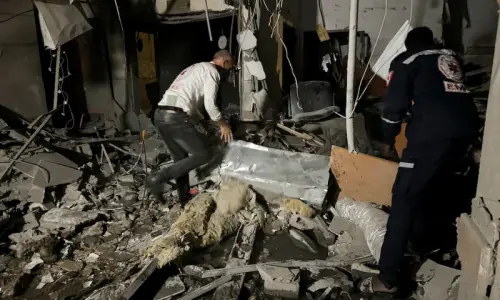
And how will the Palestinians react themselves? Israel’s military campaign which, apart from targeting innocent civilians and healthcare workers among other professionals, has destroyed some 80 per cent of homes, schools, hospitals, universities, libraries and even more significantly the utilities infrastructure, as the Gazans returning to the north of the Strip are witnessing. But Israel’s scorched earth policy has not broken their will.
There is no water, shelter, electricity or sewerage facility. The UN agency UNRWA, which is said to meet some 70pc of the food needs of Gaza, has been told to pack up by Israel but it insists on continuing its sterling work. The colonial, Zionist-supremacist state seems hell-bent on obliterating Gaza as a Palestinian enclave, which is how it has existed since the Nakba.
But, despite the seeming impossibility of creating even the most basic conditions for human habitation, many of those returning to the north of the Strip thus far have expressed a resolve to live or die on their land. There have been clips on social media showing them kneeling and kissing the soil where it is possible, and the rubble elsewhere, in the only homeland they have known.
Israel’s Greater Israel map publicly presented by Netanyahu sees the apartheid state expanding from the river to the sea. Whether the world, and more significantly the regional powers, will stand by and watch the Palestinians being slaughtered and then expelled from the ever-shrinking spaces in their own homeland, or try to say enough, isn’t clear.
The one thing that could influence the ‘war-averse’ transactional president is Saudi Crown Prince Mohammed bin Salman’s offer of a $600 billion investment in the US. Whether Saudi Arabia is prepared to link any such move to a resolution of the Palestine dispute is another matter that will become apparent as the Trump plan starts to take shape.
The writer is a former editor of Dawn.
Published in Dawn, February 2nd, 2025