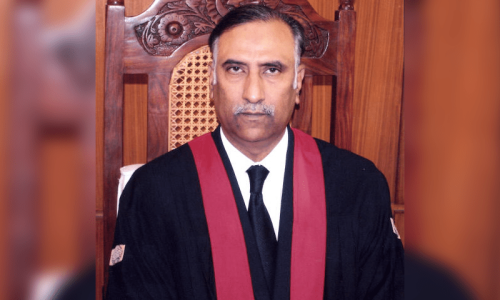
THE judges of the Islamabad High Court had issued an SOS. It was swept aside with customary disdain.
Though five judges of the court had, through a letter, expressed strong reservations about a plan to transplant judges in the IHC from other courts, President Asif Zardari did just that late Saturday. It remains to be seen whether one of the relocated judges will also end up as chief justice of the IHC, as had been feared. Given the government’s bent, it would not be a surprise. It had long been anticipated that the IHC and its judges would be penalised at an opportune time for complaining to the former CJP against the establishment’s meddling in court affairs.
If the senior-most judges are so helpless, what hope does the common citizen have? Who do ordinary Pakistanis turn to for justice, when it is becoming increasingly clear that even those supposed to uphold it do not have any for themselves?
The judges’ fears, expressed in the letter, were never unfounded. The nation had witnessed a capable Supreme Court justice being denied a well-deserved promotion, apparently only because of their refusal to agree with the position taken by the ruling regime in a key case. Other developments — especially regarding the fixing of important cases and major appointments — further cemented perceptions that the judiciary was being consciously remoulded to guarantee the continuity of the status quo. The president’s decision merely affirms the trend.
However, the ruling regime will not always be able to push everyone standing in its path against the wall. There will come a time when reactions will not be limited to mere letters and protestations. The laws of nature suggest that all systems eventually revert to their mean position. And so, at some point, the architects of Pakistan’s present-day policies will confront the consequences of their decisions. How those consequences play out will depend on what strength remains in the state’s institutions.
Right now, all roads seem to lead to dystopia; to an oppressive future characterised by totalitarianism and general tyranny. This may seem like an overly gloomy prognosis to some. Realistically, however, it is difficult to expect much from a system that is gradually becoming completely divorced from any objective measure of fairness. There is a reason justice is such a cherished ideal in all stable societies: it allows their systems to correct course quickly and without incurring painful costs.
Pakistan needs its judiciary to be able to ensure justice for its citizens. Without public faith in its justice system, it runs the risk of accelerated social breakdown. A nation so young and so full of potential should not be bled of its hopes for a fairer future. The gradual slide towards anarchy must be reversed.
Published in Dawn, February 2nd, 2025