ARCHITECTURE: AN AIRPORT CALLED HOME


 0
0

I grew up with the Jinnah Terminal.
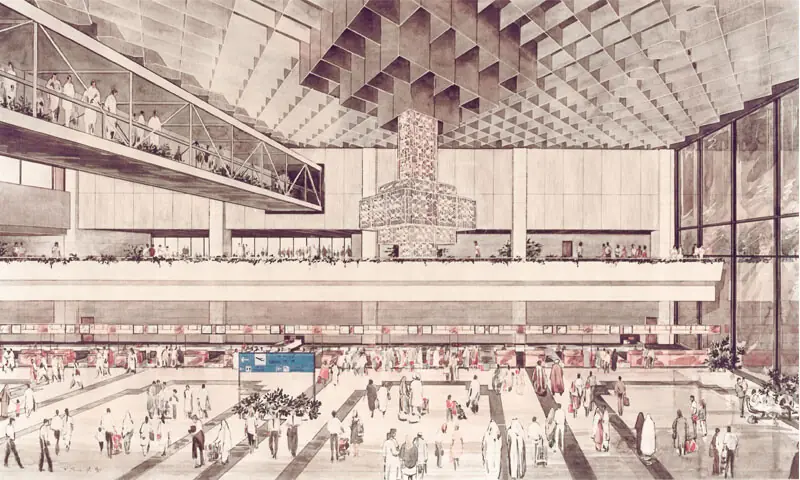
Not in the way many Pakistanis have done — as a place of departure and arrival — but as a building that existed, quite literally, in the background of my childhood. Architectural drawings of the unbuilt airport project lay open at home; conversations about structure, materials and deadlines peppered dinner conversations.
As the daughter of the project’s chief architect, Mukhtar Husain, I first encountered the airport as an idea. Long before I understood what architecture was, I understood the importance of this building as it took shape in front of my eyes. Entrenched within the narrative of my childhood, it eventually became familiar to millions.
GROWING UP WITH A TERMINAL
Airports are among the few civic spaces where private emotions play out in full public view. Departures fracture families across continents; arrivals collapse distance and separation into moments of joy. In a country shaped profoundly by migration and diaspora, these rituals carry particular weight. For millions of Pakistanis, these moments have taken place against the backdrop of the Jinnah International Airport terminal in Karachi.
Since its inauguration in the early 1990s, the terminal has served as Pakistan’s principal gateway to the world. Generations of travellers passed through its concourses — students leaving to study abroad, workers heading to the Gulf, families welcoming relatives home. The building marks the threshold between Pakistan and the world, while being steadily adapted and modified to fit changing policies, technologies and institutional priorities.
For the architect daughter of the Jinnah Terminal’s chief architect, the Karachi airport is not just a place of arrivals and departures but a living archive of memory, design and family history
For me, it has always existed simultaneously as a piece of national infrastructure and as a deeply personal landscape. I have returned to it year after year since first leaving Karachi as a student nearly 30 years ago. I became an architect myself, living and working abroad and, eventually, a mother travelling with my son; design is now as much a part of his childhood as it was mine. We move through the same halls that once existed only as hand-drawn blueprints on our dining table, hearing echoes of the nearly-forgotten conversations that shaped them.
My son, who only knows Pakistan from his brief, annual visits to Karachi, has come to know this building through stories — his grandfather’s recollections of its making — and through the tactile reality of the spaces themselves.
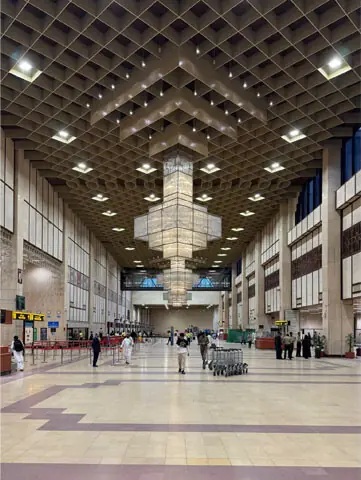
When he told his grandfather how much he loved the marble fountain on the way to the satellite, my father explained to him how he had wanted to create a peaceful respite after every traveller’s stress going through the immigration line. The carved wooden screens, the carpets lining the check-in hall, the scale of the geometric chandeliers matching that of the halls themselves: ideas initially abstract, made concrete into spaces we encounter, materials we question, and experiences we have lived through and recognise.
The terminal continues to operate not only as a gateway between countries, but as a bridge between generations.
FROM BLUEPRINT TO BUILDING
The Jinnah Terminal project began in the mid-1980s, at a moment when Karachi was still Pakistan’s most international city and its principal aviation hub. Long-haul flights between Europe and Asia often required intermediate stops and Karachi’s geographic position made it a strategic transit point.
The Civil Aviation Authority (CAA) commissioned the project, with technical support from Air Consult, the design arm of the Frankfurt Airport Authority, who brought their expertise in analysing complex data and translating it into architectural form. The Pakistani public engineering consultancy National Engineering Services Pakistan (Nespak) coordinated the project, assembling a team of nearly a hundred professionals. Among them was my father, Mukhtar Husain, who was appointed chief architect of the airport project.
ARCHITECTURE AFTER DATA
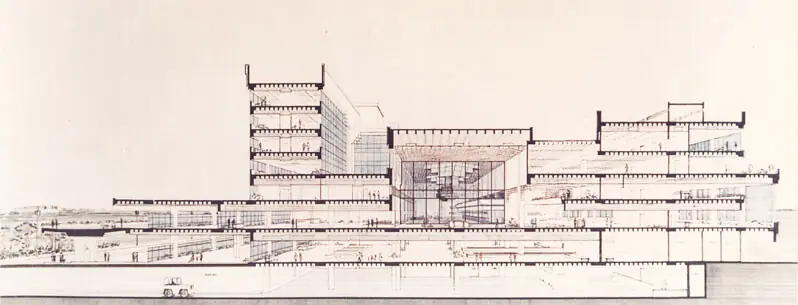
Airport design begins not with aesthetics but with statistical analysis. Economic forecasts, air traffic projections and patterns of passenger movement determine the building’s scale and organisation. Two parallel traffic systems — air and car — form the basis of these calculations, while the building itself facilitates the movement of passengers from one system to the other.
“An airport,” my father explains, “is essentially a processing machine for passengers moving from land to air and back again. But once these technical parameters define the building’s primary massing, architecture enters the picture.”
For the Pakistani design team, the central question became how this gateway to the country should be experienced — and what it should represent.
International airports are inherently global spaces — their infrastructure held to universal standards, their systems largely interchangeable. Yet they are also places of representation. The design team recognised this as an unparallelled opportunity; for many travellers, the airport would form their first and last impression of the country. They wanted to convey — in architecture — a sense of Pakistan: modern, confident and rooted in its own design language.
“The airport should give passengers a first and lasting impression of Pakistan’s rich cultural and architectural heritage,” my father recalls.
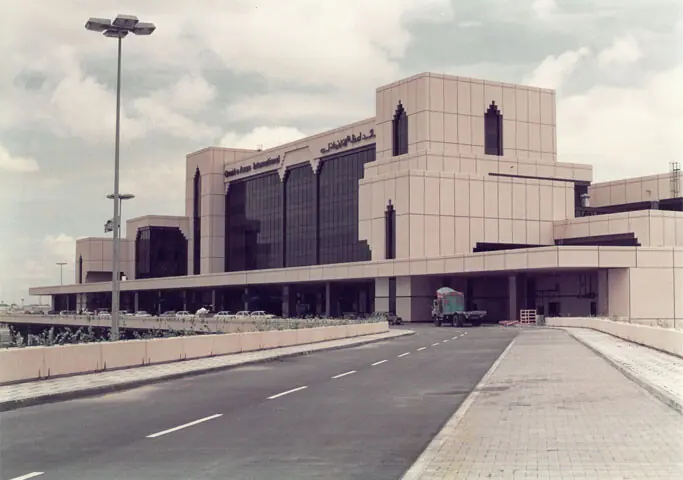
The building’s overall geometry — its large halls, wide spans and satellite concourses — was primarily dictated by functional requirements under the guidance of Air Consult. But once these volumes were established, the design team at Nespak turned to questions of identity. The exterior form emerged as a contemporary composition that subtly referenced traditional architectural geometries, establishing a framework that extended into the interior design.
The construction contract was awarded to the French firm Sogea, whose exacting standards pushed local manufacturing and construction capabilities to new limits. The building’s precast concrete façade panels, for instance, required nearly a year of experimentation at a purpose-built facility, to achieve the desired colour and texture. Decades later, that same cladding has endured with minimal deterioration — a testament to the rigour of its execution.
Between international expertise and local craftsmanship, the result was a hybrid architecture: technologically modern, yet embedded in local material culture. Nowhere was this more evident than in the interior.
WHERE CULTURE BECOMES STRUCTURE
The scale of the building created expansive volumes — spaces that were both an opportunity and a challenge.
My father had initially envisioned integrating large-scale artworks by leading Pakistani artists into these interiors: murals, reliefs and suspended sculptures that could be experienced from multiple vantage points, radiating colour against the subtle neutrals of the building interior. These works, he imagined, would be a counterpoint to the architecture — showcasing masterpieces to be admired and enjoyed by all who passed through.
When budget constraints made this impossible, the design team pivoted to a quietly radical approach, which seems to have withstood the tests of time. Instead of treating cultural expression as an applied decorative layer, the design team embedded it directly into the building’s fabric. Craft was not applied as ornament; it was built into the fabric of the structure.
The wooden lattice screens visible from the check-in hall conceal office windows on the upper levels. Designed specifically for the project and executed by local artisans, they draw upon a long tradition of the jaali — a lattice screen carved in wood and transforming a functional requirement into an architectural feature. The geometric motifs extend from these lattice screens to the baffle ceiling, the terrazzo floor and the wall panelling.
Based on the modular grid of the building, the patterns repeat at varying scales, adapting to different surfaces while maintaining a visual coherence. These were not decorative gestures. Each element was part of the building’s logic, embedding Pakistani craft traditions into its operational fabric.
In the vast check-in hall, acoustic considerations led to further integration of local material culture. Inspired by bedcovers and cushions from our own home, local hand-loom fabrics were adapted, treated, and installed at scale, drawing on the expertise of Pakistan’s extensive textile industry.
Alongside these, hand-knotted carpets produced in Karachi and Hyderabad were incorporated into the panelling. Woven in silk and executed in multiple colour variations, they form a continuous band across the departure hall walls. Their production was distributed among individual weavers, many working from their homes, yet brought together into a unified composition. They are both functional and expressive — absorbing sound while asserting a distinctly local craft tradition.
The “harder” finishes of the interior followed a similarly considered approach. A palette of warm browns and beiges established continuity between the exterior and interior, with marble accents — like the occasional fountains — introducing variation. Terrazzo flooring, manufactured locally through a dedicated facility, provided a durable surface capable of withstanding heavy use with minimal maintenance.
Lighting, too, was conceived architecturally. In the check-in hall, large geometric chandeliers descend into the space at regular intervals, their scale responding to the volume of the hall. Their form echoes the geometry of the building itself, transforming lighting into a sculptural element.
These elements were designed as long-term components, intended to endure. And remarkably, most of them still do.
CHANGE AND CONTINUITY
Each time I encounter these spaces, I experience both familiarity and recognition. Details that existed in fragments, that were deliberated over and experimented with, have not just become material, but have been witness to my own arrivals and departures for decades. The building reveals itself not as a single gesture, but as a series of decisions, each carrying intention and care.
An added layer is travelling through it with my son, which draws endless questions from him about why things look the way they do, and so decidedly different from the myriad other airports he has experienced.
In answering him, I find myself retracing the logic of the building — explaining how design decisions were made, how local crafts were incorporated, how a space can be both functional and expressive. How these decisions perfectly sum up his grandfather, the very essence of the person — and the architect — that he is. The terminal continues to do what it was always intended to do: to represent something of Pakistan, not only to those arriving for the first time, but to those returning, yet again.
Over the years, we have all seen the building change — from drastic operational adjustments that immediately followed its opening, to requirements evolved with security concerns, to incremental modifications that altered usage. Some of these changes were undeniable and essential. Others were perhaps less considered.
The building continues to function but its original clarity, at times, seems obscured — ripe for change. Airports designed nearly 40 years ago must respond to new demands: evolving technologies, changing passenger expectations, the sheer wear of time. Yet, in a country where architectural heritage is often treated lightly, this urgent need for change may easily become a moment of erasure.
Buildings must evolve. Materials age. Technologies advance. New requirements emerge. But any upcoming renovation will not simply be an opportunity to update materials or modernise systems. It will be a moment that will determine how the building is carried forward for the next generations — whether the existing, underlying ideas are understood and reinterpreted, or whether they are completely replaced.
Such decisions require a particular kind of attention — one that recognises architecture not simply as surface and space, but as a system of relationships between structure, material, meaning and experience.
The Jinnah Terminal, with its perpetual smell of rose petals strewn across the floor, is precisely that — a space of collective experience, shaped by decades of departures and arrivals. It is also a record of a particular moment in Pakistan’s architectural history — when local architects, working alongside international collaborators, sought to create modern buildings that were culturally grounded, shaping the skyline of our fast-growing cities.
For those of us who pass through it — whether once a year or once in a lifetime — it becomes part of a larger narrative: of movement, of belonging and of connection to a place.
If a renovation is undertaken, the question will not be whether the building should change. It is whether, in changing, it will still carry forward the ideas that shaped it — so that future generations, moving through its spaces, may recognise a glimpse of where they come from.
The writer is an architect and interior designer based in Paris, France. She can be reached
at asma@ateliervarenne.com
Published in Dawn, EOS, June 7th, 2026