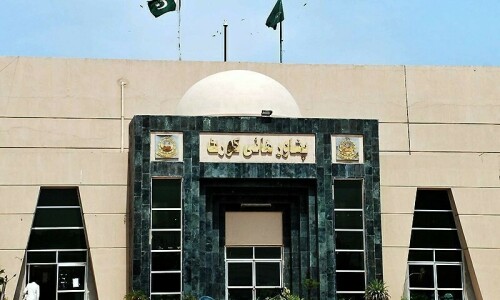
ISLAMABAD: The Judicial Commission of Pakistan (JCP) has appointed ten additional judges to the Peshawar High Court (PHC).
The commission’s meeting on Saturday approved the nomination with a majority and decided that nominees who did not secure the required votes this time will be reconsidered for future vacancies.
Those who have been nominated as additional judges are advocates Muhammad Tariq Afridi, Abdul Fayaz, Sabitullah Khan, Salahud Din, Sadiq Ali, Syed Mudasser Ameer, Aurangzeb and Qazi Jawad Ehsanullah; and district and sessions judges Farah Jamshed and Inamullah Khan.
Initially, the agenda stated that it would only discuss the nominations.
Meeting held only to discuss nominations ends up approving them; PBC rejects changes to law governing bar elections
However, at the start of the meeting on Saturday, PHC Chief Justice Ishtiaq Ibrahim suggested the commission approve the nominations.
A source told Dawn that the suggestion was endorsed by Chief Justice of Pakistan (CJP) Yahya Afridi, who heads the commission.
However, the Supreme Court’s senior puisne judge, Justice Syed Mansoor Ali Shah, suggested the meeting stick to the original agenda to “ward off any doubts” in future appointments.
The nominees of Law Minister Azam Nazeer Tarar, PPP Senator Farooq H. Naek, and Pakistan Bar Council representative Akhtar Hussain received 10 to 11 votes from the commission’s 13 members.
The nominees suggested by PTI’s Barrister Gohar Ali Khan and Senator Ali Zafar failed to get any votes.
The nomination of one of the nominees was approved after the individual submitted a certificate renouncing their UK nationality, the source said.
PBC rejects amendments
Separately, the executive committee of the Pakistan Bar Council (PBC) has rejected the amendments in the Legal Practitioners and Bar Councils Act, 1973, proposed by the Ministry of Law and Justice.
The committee’s meeting in Peshawar discussed the draft of amendments to sections 5A and 11A to increase the length of practice as a high court advocate.
The draft recommended that the length of membership for being eligible to contest elections for provincial/Islamabad bar councils be increased from five years to 10 years.
The total length of practice as an advocate should be increased from 15 years to 20 years.
Similarly, to contest the election of the Pakistan Bar Council, the term limit for practice as an advocate of the Supreme Court should be raised from 15 to 20 years.
The length of practice as an advocate of the Supreme Court required to become a PBC member was proposed to be increased from five years to 10 years.
The committee unanimously opposed and rejected the amendments and said the prevailing length of practice was a “sufficient qualification” to become a member of bar councils.
There is no need to increase the practice length as it would “deprive” young lawyers of the chance to contest bar elections.
Young lawyers should be encouraged to contest these elections as they contribute significantly to the legal profession and the bar.
Published in Dawn, February 2nd, 2025