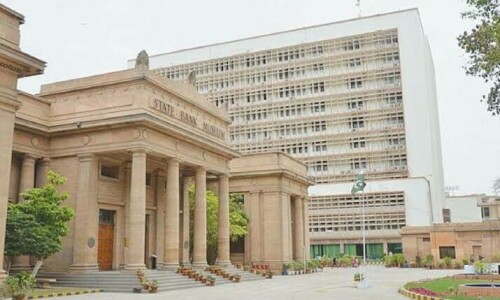
HAVING slashed its key policy rate by yet another 100bps to 12pc, the bigger question for the State Bank now is whether or not it should pause the ongoing monetary easing cycle, which has seen the rate being cut by 1,000bps since June to preserve the recently achieved fragile stability.
Though the bank had long stopped providing forward guidance on interest rates, the latest monetary policy statement and its governor’s post-policy briefing offer some insights into the SBP’s thought process. On the one hand, it believes that a “cautious monetary policy stance is needed to ensure price stability … for sustainable economic growth”. This demands that the real policy rate “remain adequately positive on a forward-looking basis to stabilise inflation in the target range of 5-7pc”.
Moreover, the risks to inflation — volatile global commodity prices, protectionist policies in major economies, timing and magnitude of administered energy tariff adjustments, volatile perishable food prices, and any additional tax measures to meet the FBR target — call for a pause on monetary easing, or at least moderation in the pace of rate cuts.
On the other hand, the current account is expected to run a surplus of 0.5pc of GDP, with international reserves rising on increased remittances and a slight growth in exports in spite of heavy debt payments, while the bank has revised down its projections for the average annual inflation to 5.5pc-7.5pc, or close to its targeted range, from its original estimate of 11.5pc-13.5pc for this fiscal year. This means that the SBP still has enough room to continue the monetary easing cycle as real interest rates stand at 790bps, much higher than the historic average of 200-300bps.
Indeed, the economy appears to have turned a corner in the last several months. The improving indicators can be tempting enough to act boldly in order to accelerate economic growth. But must the bank go for this path and repeat past blunders?
In spite of the recent recovery, the economy remains on edge. The 45.5pc reduction in interest rates in seven months should be enough, at least for now, to send a positive signal to the private sector. It is time to prioritise long-term stability over unsustainable faster growth driven by imported consumption. We have seen the economy experiencing severe balance-of-payments crises as recently as in 2018 and 2022 due to the elites’ impatience with stabilisation policies.
Chasing growth without executing structural reforms in an uncertain global environment — in which the possibility of a global trade war in the wake of President Donald Trump’s threats to impose tariffs on America’s trade partners and rivals alike — can be suicidal. The wealthy elites will escape the impact. But it will crush middle-class households who have borne the brunt of the economic instability.
Published in Dawn, January 28th, 2025