0
0

A European twist on furoshiki, Japanese wrapping cloth, is opening up a new world of wrapping as sustainability trends revive the traditional practice.
Anna Papai-Vonderviszt, 40, a furoshiki designer from Hungary, presented boxes and books wrapped with furoshiki featuring knots made to look like extravagant flowers, such as dahlias and roses. She also recommended imbuing a scent like rosewater to add extra charm. Born in Veszprem, Hungary, in 1984, she spent about six years of her childhood in Japan over two separate periods due to her father’s work.
Having worked as an interpreter since her time as a student, Papai-Vonderviszt has been involved in exchanges between Hungary and Japan. She also studied haiku while at university and has worked as a business consultant.
From 2012 to 2016, she served as secretary general of the Hungary-Japan Friendship Society. These experiences, she said, led her to become fascinated with furoshiki. “I was impressed not only by its tradition, but also by its being environmentally friendly,” she said. According to Papai-Vonderviszt, there is a practice of farmers wrapping bread in cloth to take it out to fields in Hungary, too.
Having studied basic furoshiki techniques in Japan, Papai-Vonderviszt launched the furoshiki brand floWeRAP in 2018, in collaboration with a Hungarian designer.
The brand’s furoshiki are usually 70 centimeters square, with patterns designed so the knots evoke leaves or flowers like dahlias, roses, poinsettias and sweet peas, when wrapped. There are also furoshiki bearing animal or architectural patterns.
She showed me how to wrap something in furoshiki; it only took her about a minute. “You can learn how to use furoshiki in about an hour,” Papai-Vonderviszt said.
Furoshiki can provide an exciting and surprising unwrapping experience for gift recipients.
Papai-Vonderviszt also holds furoshiki workshops in Japan when she visits, as a way to promote cultural exchange based on furoshiki. “I also want to work with Japanese designers to spread this wonderful culture around the world,” she said.
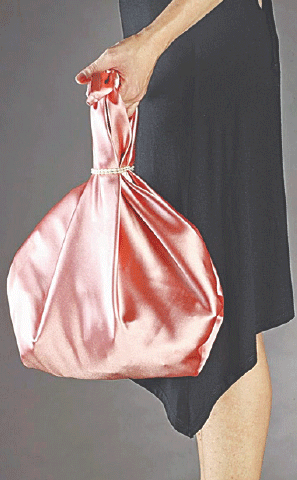
Furoshiki can be made into bags by tying the ends together. Papai-Vonderviszt herself learned how to make a bag with furoshiki in Japan.
Furoshiki bags include those shaped like shizuku (droplets), that are easy to tie and to put things in or take them out, or with wide openings like tote bags. There are many other shapes furoshiki bags can take.
“You can choose furoshiki with a pattern you like and make a bag with it. It’s fun,” she said.
Published in Dawn, January 13th, 2025