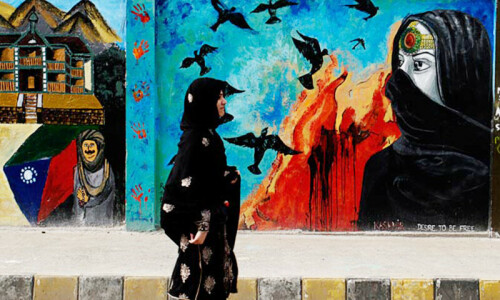
Women’s participation in the economy, especially in the use of technology and digital spaces, remains “alarmingly low”, a report issued by the Pakistan Telecommunication Authority (PTA) said on Thursday.
According to a report by the Organisation for Economic Co-operation and Development called ‘Bridging the Digital Gender Divide’, globally, approximately 327 million fewer women than men have access to smartphones and the mobile Internet.
Locally, as technology and internet usage continue to expand in Pakistan, the issue of the digital gender divide remains a critical concern. Despite a significant increase in internet users, with a rise of 22 million (35.9pc) between 2021 and 2022, overall internet penetration remains below 40pc, according to a United Nations Development Programme blog.
In their annual report issued last week, PTA said that the participation of women “especially in the use of technology and digital spaces”, remained “alarmingly low”.
It said that Pakistan ranked among the “lowest in terms of gender parity and digital inclusion”.
While citing three separate reports — Global Gender Gap Report 2024, the Mobile Connectivity Index 2023, and the Inclusive Internet Index — PTA said that the reports highlighted “significant gaps in female education, mobile ownership, and internet usage, underscoring the need to bridge the digital divide and promote equitable access to technology”.
The report said that key challenges faced by women included “limited digital literacy, restricted access to financial services (such as bank accounts), absence of national identity (CNIC) for nearly 25 per cent of adult women, high costs of devices and broadband, scarcity of local content, safety concerns, and patriarchal controls”.
It said that out of a total of 60.4 million users of Facebook, 77pc were men while 24pc women. Youtube saw 71.7m users from Pakistan out of which 28pc were women. Similarly, TikTok saw 54.4m users which saw 22pc women only. Instagram had 17.3m users which had 36pc women.
According to the report, the PTA, as a response, developed the Digital Gender Inclusion Strategy under the patronage of the Ministry of Information Technology and Telecommunications.
The strategy would have support from Unesco Pakistan and would address “the barriers hindering women’s access to mobile”, setting “forth an accelerated action plan with an implementation roadmap, timelines, and measurable outcomes”.