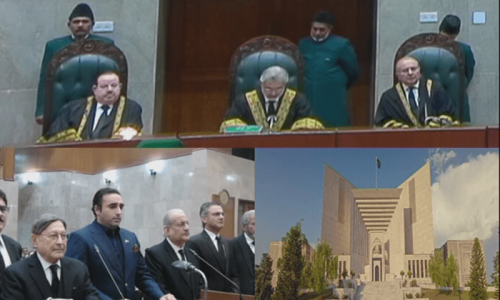
ISLAMABAD: Chief Justice of Pakistan (CJP) Yahya Afridi on Tuesday called the murder trial of late prime minister Zulfikar Ali Bhutto a sobering reminder of how deviations from constitutional governance could unduly influence judicial proceedings in politically charged cases, undermining the ideals of impartiality and due process in such exceptional circumstances.
“This also accentuates the importance of recognising the courageous dissents of Justice Dorab Patel, Justice Muhammad Haleem and Justice G. Safdar Shah who stood their ground despite the prevailing atmosphere,” observed the CJP in a five-page note he issued on the presidential reference in the murder trial of PPP founder.
Their dissents, even if unsuccessful in altering the outcome, remain a testament to the enduring principles of judicial integrity and impartiality, underscoring the value of an independent judiciary committed to the rule of law, the CJP said in his note.
On March 6, the Supreme Court, after a delay of over 44 years, corrected a historic wrong by acknowledging that the murder trial of Zulfikar Ali Bhutto was unfair and lacked due process, both at the trial stage and in endorsement of the verdict by the appellate court.
In his note on reference, Justice Afridi says manipulation of bench’s composition raised fairness concerns
CJP Afridi regretted that the extraordinary political climate of the time and the pressures inherent in such an environment appear to have influenced the course of justice in a manner inconsistent with the ideals of judicial independence.
“It is, however, very pertinent to note that the present reference was avowedly filed against the backdrop of the restoration of the judiciary and the proactive role of the restored judiciary in addressing the matters of public importance,” he said.
He explained that the presidential reference highlighted the ‘admission’ of former CJP, the late Justice Nasim Hasan Shah, regarding external pressures in the decision of Mr Bhutto’s appeal, describing it as a regrettable chapter in the judicial history.
He was of the view that the reference might never have come before the court if not for the events recounted and the facts disclosed in the interview and autobiography of Justice Nasim Shah.
In the SC judgement, Justice Nasim Shah rejected the contention that the trial of Mr Bhutto was vitiated by bias on part of Justice Maulvi Mushtaq Hussain, who presided over the Lahore High Court during the trial. However, this stance directly contradicts his later remarks in an interview with Iftikhar Ahmad for the programme “Jawab Deyh”. In the interview, Justice Shah described Justice Maulvi Mushtaq as an overt enemy of Mr Bhutto, stating he should not have been part of the LHC bench.
In fact, the presence of Justice Maulvi Mushtaq on the LHC bench was referred to as Ziadati, a term that, within the context of the trial, could only be interpreted as bias. This clear contradiction in the views of Justice Nasim Shah raised concerns about the evaluation of the question of bias on part of Justice Mushtaq in the appeal.
Justice Nasim Shah revealed certain facts in his autobiography Memoirs and Reflections, suggesting that his inclusion in the bench for hearing Mr Bhutto’s appeal was orchestrated by Attorney General Sharifuddin Pirzada and Justice Maulvi Mushtaq.
Such manipulation of the bench composition undermined judicial impartiality and raised serious concerns about the fairness of the proceedings, CJP Afridi said.
He added that it demonstrated how Justice Maulvi Mushtaq pursued the matter zealously even after the high court had decided the case and the appeal was pending before the Supreme Court, despite his role having concluded with the decision of the high court.
This unwarranted involvement after conviction blurred the boundaries of judicial propriety and eroded confidence in the impartiality of the appellate process, the CJP stated. These accounts of events effectively undermined the expected impartiality of judicial decision-making in the trial of Mr Bhutto. If left unaddressed, such events risked eroding public confidence in the fairness of the judicial process, he observed.
Published in Dawn, December 18th, 2024