PAKISTAN is the result of a long struggle under the charismatic personality and leadership of Quaid-i-Azam Mohammad Ali Jinnah, who, like a great statesman, was honest and truthful in all his dealings and relentlessly carried out the freedom struggle based on principles of professional politics and uprightness.
I am a super-senior citizen and a humble student of Pakistan affairs since its early days. The All-India Muslim League (AIML) under the statesmanship of the Quaid never resorted to sit-ins of any kind, and never adopted the hunger strike as a tool for protest. In contrast, the Indian National Congress (INC) used such tactics, and the Quaid was never impressed by the approach.
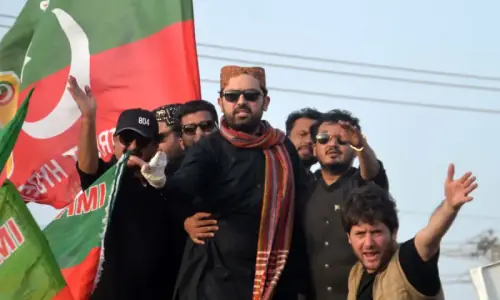
We all talk about our rights and privileges, but have no respect for the rights of others. A golden rule of political science is that one’s freedom ends where the other’s nose begins. The sit-ins cause great disruption to civic life which is a gross violation of people’s rights.
It is time to shun politics of sit-ins by all political parties. To the best of my recollection, even in the early days of Pakistan, there were no sit-ins. The political movement against the misrule of Iskandar Mirza, headed by Sardar Abdur Rab Nishtar and many other leaders of the Pakistan movement, never resorted to such tactics. They took out a massive procession in September 1958, which unnerved the government to the extent that it ended up declaring the country’s first martial law. It was only in the 1970s that sit-ins crept into national politics, with the negative trend touching its peak during the last decade.
I would suggest that the government issue a white paper, covering all sit-ins held since 1970. It should include the details about the inconvenience caused to the public and the financial loss suffered by the national economy, so that the people should know the adverse impact of such an approach.
The matter should not be left to the level of district administration. Instead, an act of parliament should be passed to prohibit sit-ins, hunger strikes and road closures. At the same time, proper facilities must be provided to the people and political parties to vent their grievances and put up their demands in a peaceful manner.
A specific place should be earmarked in all the major cities and every district should have such places. The designated places should have all the administrative facilities, including support for the media. Hyde Park in London is one such role model to be adopted.
If we follow the British democratic system, why not the Hyde Park model? The Council of Islamic Ideology (CII) should not remain silent on this vital issue. It must give its statement about the violation of the concept of Huqooq-ul-Ibad.
Lt-Col (retd) Syed Iftikhar Ahmed
Karachi
Published in Dawn, December 15th, 2024