CONSIDERING that Balochistan has been experiencing a steady wave of terrorist violence over the past few months, particularly involving Baloch separatist groups, it is no surprise that the state has decided to use armed force to quell the insurgency.
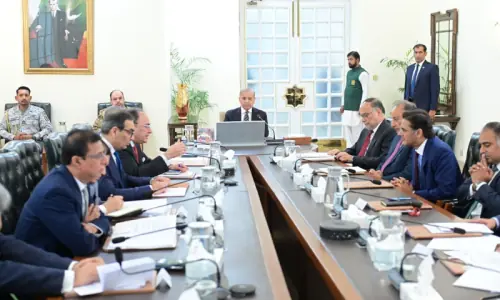
Using the platform of the Apex Committee, the civil and military leadership said on Tuesday that an operation would be launched to counter terrorism and separatist violence in the province, while Nacta would be revitalised under the vision of Azm-i-Istehkam. The meeting also announced that a National and Provincial Intelligence Fusion and Threat Assessment Centre would be created and a “whole-of-system approach” adopted.
It is clear why the state has to take firm action to restore peace in Balochistan. In August, terrorists launched a coordinated series of attacks in different parts of the province; such incidents have been occurring since then with disturbing regularity. They include the massacre of miners in Dukki in October, as well as the bombings in Mastung and at the Quetta railway station earlier this month. In fact, the railway station atrocity, in which a large number of civilians were martyred along with security personnel, may have played a decisive role in the state’s decision to launch a military operation.
Apart from these incidents, there have been numerous grisly murders of non-Baloch workers, as well as the suicide bombing in October outside Karachi airport in which two Chinese nationals were killed. The latter incident threatened to imperil Pakistan’s relationship with Beijing. All these violent acts have been linked to Baloch separatists.
Yet it should be remembered that although Balochistan has witnessed numerous military operations over the decades, they have largely failed to bring long-lasting peace to the province. This time, with Nacta on board, things could be different. While the state goes after terrorists, innocent people should not be hauled away and there must be transparency regarding the operations. If relatives of the insurgents, especially women and children, are targeted in the name of tackling terrorism, it will be counterproductive and breed more disaffection.
As this paper has said before, while restoring peace is essential, addressing Balochistan’s socioeconomic deprivation is equally important as terrorists exploit poverty and underdevelopment in the resource-rich province to turn people against the state. Moreover, the state will need to keep channels open with the Afghan Taliban to ensure that Baloch insurgents are not able to find sanctuary in their country.
Better ties with Kabul can help thwart the malignant designs of the “hostile foreign powers” that the Apex Committee identified. Some regional states, such as India, are deepening relations with the Afghan Taliban. For peace in Balochistan and elsewhere in the country, Pakistan cannot afford to ignore these developments and must keep the lines open with Kabul.
Published in Dawn, November 21st, 2024