Seven-judge constitutional bench assumes full court role


ISLAMABAD: In a loud and clear message, the seven-judge constitutional bench on Tuesday clarified that, for all practical purposes, it functions as the full court for hearing constitutional matters.
The observation appears to resolve uncertainty surrounding the handling of constitutional cases which, before the passage of the 26th Constitutional Amendment, were heard by the full court comprising all available Supreme Court judges. One such case is the reserved seats verdict, which was heard by a full court comprising 13 judges, the review petition of which has yet to be taken up by the SC.
Similarly, several petitions have been filed in the SC challenging the validity of the 26th amendment. In all these challenges, the petitioners have requested that the matter be heard by a full court consisting of all the judges of the top court.
Tuesday’s observation came as the seven-judge constitutional bench took up a case relating to the levy of cess on different ghee manufacturing mills.
Justice Mazhar observes concept of full court redundant after 26th amendment
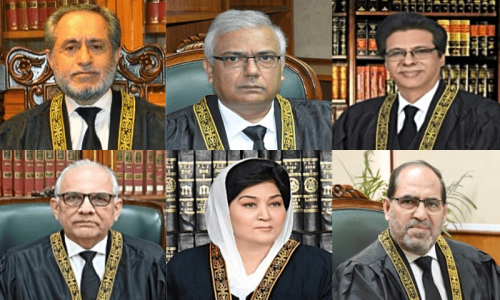
Headed by Justice Aminuddin Khan, the bench comprised Justices Jamal Khan Mandokhail, Muhammad Ali Mazhar, Ayesha A. Malik, Syed Hasan Azhar Rizvi, Musarrat Hilali and Naeem Akhtar Afghan.
During the hearing, when one of the counsel pointed out that a judgement on the matter had been delivered by the full court, Justice Mazhar explained that the concept of the full court had become redundant following the adoption of the 26th amendment.
“Consider this seven-judge constitutional bench as the full court now,” Justice Mandokhail observed, adding that he should recuse himself from the case since he had been a member of the Balochistan High Court, which had previously decided the present matter.
The bench, however, issued notices to all provinces and adjourned the hearing indefinitely.
Talking to the media, senior counsel Hamid Khan said the bench should wait for the outcome of the challenges to the 26th amendment by a full court to ensure its validity is determined once and for all. He opposed the idea of the constitutional bench hearing petitions challenging the vires of the amendment.
He asserted the constitutional bench was merely one of the SC benches and did not have the authority to declare itself the full court. He was of the opinion that the 26th amendment had created two rival courts within the SC. “It is our demand that challenges to the amendment should be heard by a full court comprising all judges of the apex court,” he said.
Case sent back to regular bench
Also, the constitutional bench referred a case back to a regular bench headed by Justice Mansoor Ali Shah.
When the constitutional bench took up an appeal filed by Saeed Ahmed Khoso through his counsel Liaquat Tareen, Justice Aminuddin questioned how the case had been assigned to the constitutional bench.
At this, Justice Ayesha Malik explained she was part of the regular bench that had referred the matter to the constitutional bench on Oct 23, following a request by the lawyer concerned.
Justice Mazhar said that not every case should be sent to the constitutional bench, emphasising that only those involving questions of constitutional interpretation should be referred.
Petition dismissed
The constitutional bench also dismissed a petition challenging the extension granted to the army chief.
The petition, filed by Syed Mehmood Akhtar Naqvi, was rejected due to non-prosecution as the petitioner failed to appear in court.
The petition had contested the registrar office’s decision to return the case, but the court upheld the office’s objections by dismissing the appeal.
In his original petition, the petitioner had requested the SC to order that the army chief’s appointment be based on seniority, arguing that granting a three-year extension after retirement caused injustice.
Published in Dawn, November 20th, 2024