ISLAMABAD, April 10: President General Pervez Musharraf and his Yemeni counterpart Ali Abdullah Saleh on Monday agreed to invigorate the private sector participation for increased bilateral economic ties and reaffirmed their commitment to forging cooperation in terrorism jointly.
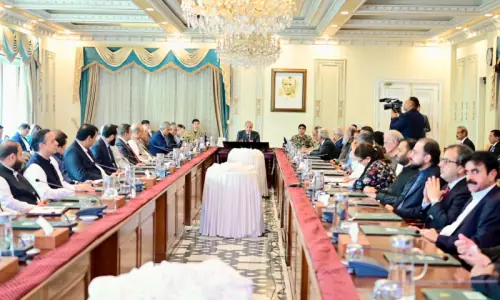
President Musharraf and President Saleh, the first Yemeni leader to visit Pakistan in almost two decades, went into talks immediately after the formal welcome ceremony for the visiting leader at the Aiwan-i-Sadr.
Later, President Musharraf told a joint press conference that Pakistan and Yemen had tremendous scope for investment, joint ventures and said their private sectors could identify products for bilateral trade.
“The government will facilitate the private sector, which should explore new areas of commerce and economic cooperation. This way we will be able to give further strength to our excellent political and diplomatic relations. We will have broad-based ties with Yemen,” he stated.
Pakistan, he said, would cooperate with Yemen in meeting needs of Yemeni police and security forces. “We will also cooperate with Yemen in the area of defence production and security-related areas.”
Gen Musharraf said the two countries had agreed to intensify intelligence cooperation to combat terrorism and extremism jointly.
President Musharraf promised to open doors of Pakistani universities to Yemeni students.
He thanked the visiting leader for Yemen’s support in the wake of Oct 8 earthquake.
The Yemeni leader described the talks as extremely productive and positive.
“We have agreed to explore more horizons for giving depth and expansion to our bilateral ties,” he said.
“I fully support President Musharraf’s call for increasing intra-OIC trade as the Muslim world has both potential and resources to bring about their collective economic wellbeing.”
President Saleh said bilateral cooperation in the field of security would be beneficial for both the countries.
TALKS: Earlier, President Musharraf and President Saleh discussed a range of bilateral, regional and international issues.
The two leaders stressed the need for promoting a better understanding of and harmony among diverse faiths and communities.
Both sides recognised that a just resolution of the Mideast conflict leading to the creation of an independent and viable Palestinian state was of great importance to the Ummah.
They expressed concern over the deteriorating security climate in Iraq and the hardships the Iraqi people were facing.
The two countries expressed the hope that Iran’s nuclear issue would be resolved through peaceful means.—APP