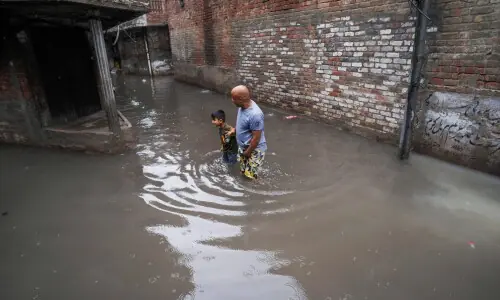
THE Air Quality Index in Lahore once again shot past the 1,000-level mark on Wednesday morning, registering at an eye-watering 1,165. The suffocating pall that has descended over the city, and also wide swathes of the province, has forced the Punjab government to announce a slew of new measures to contain its harmful, potentially life-threatening effects. Among these measures are a bar on heavy traffic in the provincial capital till January 2025, the mandatory wearing of masks, closure of educational institutions till Nov 17, and enforcement of work-from-home for half the workforce in government and private institutions. Of course, each measure will incur immense direct and indirect costs, not just for the government but also for the people. Climate activists had long warned of such consequences when they had been cautioning against unchecked industrialisation and urbanisation, a culture of wanton consumption, and our authorities’ lack of regard for the climate impact of their beloved ‘development’ projects. Alas, here we are now, with our largest province now choking on its own toxic fumes, struggling to breathe.
The Punjab government under Chief Minister Maryam Nawaz has already tried and failed to implement a new, more ‘thorough’ strategy to deal with smog. According to the Pakistan Air Quality Initiative, PM2.5 pollution, which causes the most damage to health, is up 25pc in 2024 compared to 2023; general pollution levels are also up by 23pc. Experts have already written off the band-aid measures taken by the administration, pointing out that ‘green lockdowns’ and declaring a ‘climate calamity’ will not help. It should, therefore, return to the drawing board and use the learnings from this year to plan ahead. The solution may be to enforce stricter controls to regulate heavy polluters, especially personal vehicles. Instead, public transport must be encouraged and existing facilities expanded so that people have access to options that do not cause as much environmental harm. Similarly, heavy traffic and high-emission industries must be moved away from population centres as quickly as possible. Lastly, while the CM has said she will talk to her counterpart in Indian Punjab to tackle the smog issue, she must also talk to her counterparts here in Pakistan. The prime minister, too, must take note. The climate crisis is a national issue, not just a provincial one.
Published in Dawn, November 8th, 2024