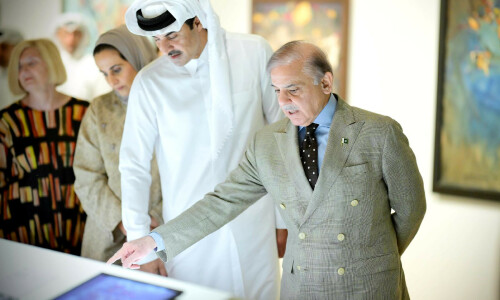
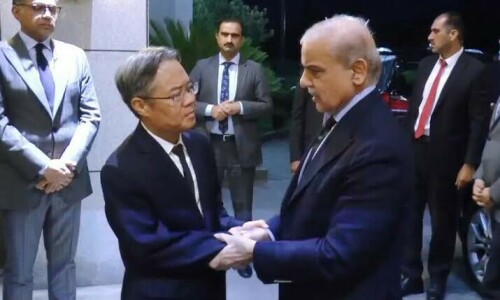
SAUDI Arabia has agreed to increase its promised investment in Pakistan by another $600m to $2.8bn, with Riyadh signing seven more MoUs during Prime Minister Shehbaz Sharif’s just-concluded visit to that country.
A Saudi delegation, led by the Saudi investment minister, had concluded 27 MoUs worth $2.2bn in Islamabad last month. The decision to boost the volume of Saudi investment in Pakistan was made after Mr Sharif’s “very productive” meetings in Riyadh. According to the Saudis, some of the MoUs have resulted in exports from Pakistan in agriculture and other sectors. After his Saudi visit, the premier reached Doha to woo Qatari investors to Pakistan.
For over a year, Pakistan has been chasing official and private investments in state-owned enterprises, agriculture, oil and gas exploration, the aviation industry, mining and other sectors of the economy. Initially, we were told that three friendly Gulf nations — Saudi Arabia, the UAE and Qatar — had pledged to invest $25bn each in Pakistan over the next five years. The previous Shehbaz Sharif government also set up the military-backed Special Investment Facilitation Council to provide ‘prospective’ Gulf investors some comfort on policy consistency.
As time passed, Islamabad continued to adjust its Gulf investment expectations downward to more realistic levels. Even then, only a fraction of what was promised has actually flowed into Pakistan: a small Emirati investment in Karachi’s port infrastructure and the Saudi acquisition of shareholding in a Pakistani oil marketing company. Contrary to officials’ claims, no Qatari or other investors from these countries have shown an interest in PIA or Islamabad airport, which the government is struggling to disinvest.
In fact, the Saudi announcement to increase its promised investment in Pakistan coincided with all but one bidder pulling back from the process of the airline’s sale. Potential Chinese investment under CPEC’s second phase also appears a distant possibility because of security concerns. China is upset not only over the terrorist attacks against its nationals working in Pakistan but also the narrative built around the power plants set up under the CPEC plan.
The one-sided revisions in their contracts being imposed on private power producers and their vilification is not helping investor confidence either. With our investment climate deteriorating amid a worsening balance-of-payments crisis and political instability, we have seen several foreign companies exit the Pakistani market in recent years.
We can appreciate the PM touring one country after another to sell Pakistan’s ‘unrealised economic potential’ to bring in the foreign investment needed to shore up our shaky international reserves and accelerate economic growth.
But these efforts will be fruitless unless he first focuses on crucial structural and policy reforms in areas that directly affect investors. Indeed, policy consistency and sanctity of contracts top the list of these reforms.
Published in Dawn, November 1st, 2024